
Visiting Porsche’s Factory and Museum in Stuttgart – My Experience
If you’ve ever dreamed of seeing how a Porsche 911 is built, the factory tour in Zuffenhausen offers a rare and fascinating behind-the-scenes experience that brings the legend to life.
Factory tours at Porsche are available in both German and English languages and can be booked online via the official Porsche website at
https://www.porsche.com/germany/aboutporsche/porschemuseum/tours/factorytours/
Visitors can choose between public or private tours, with regular tickets priced at 18 Euros. Just like at Mercedes, an online PDF ticket with a QR code will be issued after booking.
The tour begins at the entrance of the Porsche Museum, located at Porscheplatz 1. Before entering the factory, visitors must store all cameras, smartphones, and other electronic devices in lockers provided on-site. Headsets are handed out in advance, and the tour is open to children aged 8 and older. The duration is approximately 1.5 hours.
After the initial meeting point at the museum, the group crosses Porscheplatz and walks directly through the gate into the production grounds. The actual factory building, situated just a few steps away on the left, marks the start of the production experience. According to our guide, this is one of the older parts of the Porsche plant — something that becomes apparent in the layout. While the facility is more compact and less spacious than, for instance, Mercedes-Benz’s Sindelfingen plant, it feels efficient, refined, and purpose-built.
Unlike many other car factories, production in Zuffenhausen is organised vertically. The tour begins on the upper floors, where bare-metal bodies move along the line. With each descending level, the vehicles become more complete, with increasing amounts of human input and technical detail. This multi-floor design is a rarity in the automotive world but is essential in land-constrained Zuffenhausen.
A key highlight of the tour is witnessing the so-called “marriage” — the moment when the drivetrain (engine and transmission) is precisely joined with the car body. Just prior to this step, the wheels are already fitted, and the entire body is then lowered onto the drivetrain with millimetre-level accuracy. This crucial step represents both a symbolic and technical milestone in Porsche production.
At the lowest level of the factory lies the final quality control area. Here, every vehicle undergoes meticulous inspection, with particular focus on panel gaps, surface finish, and alignment. Nothing is left to chance — at Porsche, perfection is a requirement, not an option.
Like in other modern car plants, each vehicle rests on a skid equipped with a QR or barcode that contains its full specification — colour, trim, engine, transmission, and individual options. This digital tag ensures that every part and process is precisely aligned with the vehicle’s unique configuration.
A standout feature of the Zuffenhausen factory is its use of driverless transport systems (FTS – Fahrerloses Transportsystem). These autonomous robots pull small trailers filled with parts and navigate the narrow production halls entirely on their own, delivering materials exactly where needed. It’s not automation for the sake of innovation, but a practical and lean solution tailored to the plant’s tight spatial constraints.
Although not part of the guided route, the adjacent engine plant deserves a mention. Here, Porsche assembles power units not only for its own cars but also for other brands within the Volkswagen Group. The engines for the 911, however, are built much closer to the assembly line — a testament to the car’s artisanal character.
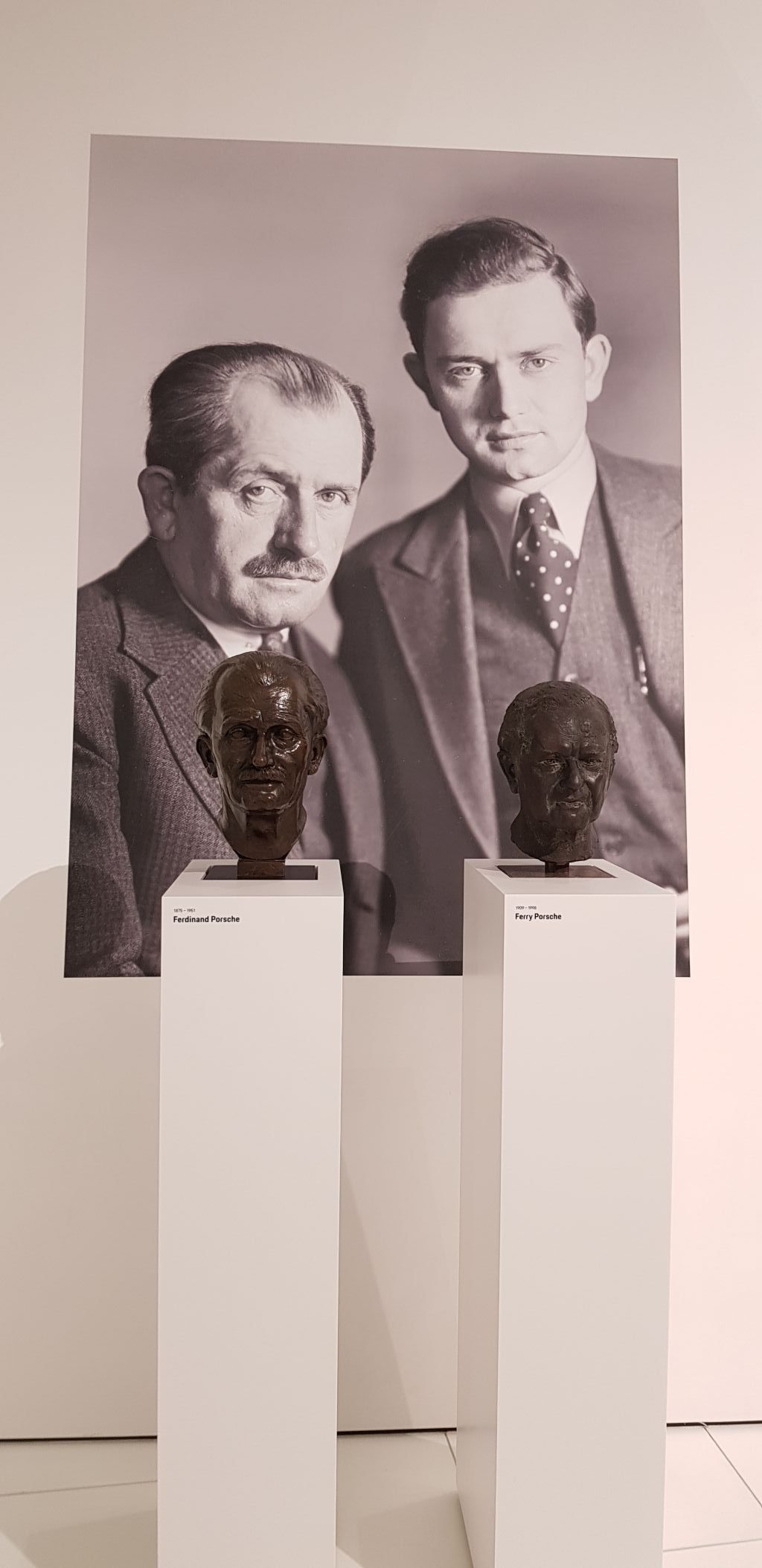
Nearby stands Werk 1 — a historic building that once served as the heart of early Porsche development. This is where Ferdinand Porsche and his team laid the foundation for what would become one of the world’s most iconic sports car manufacturers. Although no longer a production site, Werk 1 continues to symbolise Porsche’s pioneering spirit.
The entire environment in Zuffenhausen feels distinct. It’s quieter, more concentrated, more personal. There’s no sense of anonymous mass production here — what you feel instead is a fusion of craftsmanship and precision. This isn’t just about building a car — it’s about building a 911.
At the end of the tour, visitors return to the Porsche Museum, where the journey began. From there, you can buy your museum ticket at the counter and continue exploring the brand’s remarkable history in motorsport and innovation.
After returning from the factory tour to the Porsche Museum, it’s time to take a closer look at the exhibits — especially some of the most iconic models that define the brand’s heritage. Click or tip on the pictures to enlarge them.
Porsche 356 A 1500 GS Carrera Speedster (1957)
The Porsche 356 Carrera Speedster is one of the most desirable and sporty versions of the 356 series. This particular model dates back to 1957 and is powered by the legendary Fuhrmann engine (Type 547) – a highly sophisticated 1.5-liter four-cylinder unit featuring four overhead camshafts and dry sump lubrication.
With an output of around 100 horsepower and a weight of only about 800 kilograms, the Carrera Speedster could reach a top speed of approximately 200 km/h (124 mph) – an impressive figure for its time.
The Speedster version stood out with its particularly low windshield, minimalistic interior, and pure, sporty character. Originally developed for the US market, the Speedster quickly became an icon among sports car enthusiasts.
The model displayed at the Porsche Museum, labeled as exhibit number 234, features a rare blue paint finish, adding an extra touch of elegance to its classic design.

Porsche Diesel N 308 Tractor (1960)
Before Porsche became world-famous for its sports cars, the company also made a significant contribution to agricultural machinery. In the 1950s and 1960s, Porsche-Diesel tractors were a crucial part of the brand’s product line.
The Porsche Diesel N 308, built in 1960, was powered by a three-cylinder diesel engine producing around 38 horsepower. Designed for reliability and easy maintenance, it was widely used in farming and agriculture across Europe.
The example exhibited at the Porsche Museum, finished in bright red, highlights a fascinating chapter of Porsche’s engineering history – far removed from racetracks but equally important in the company’s development.

Porsche 901 Nr. 57 (1964)
The Porsche 901 represents the very beginning of the legendary 911 series. Introduced in 1963 at the Frankfurt Motor Show (IAA), the model was initially named 901 but was later renamed 911 due to a trademark dispute with Peugeot.
Exhibit number 57 in the Porsche Museum, however, is far more than just an early example – it is a true legend. Discovered in 2014 by the TV team of “Trödeltrupp” in a barn, this red coupé turned out to be one of the very first Porsche 901 production models, built in October 1964. At the time of its discovery, the car was in a poor state: it was missing its front fenders, the engine and brakes were heavily corroded, and it was buried under a thick layer of dust.
Recognizing its historical importance, the Porsche Museum acquired the vehicle for €107,000 and spent three years restoring it as authentically and meticulously as possible. Today, the fully restored car not only stands as a priceless piece of Porsche heritage but is also occasionally driven – fulfilling the purpose for which it was originally built: the pure joy of driving.

Porsche 356 C Cabriolet Polizei (1964)
This is a rare and fascinating version of the classic 356. While most 356 models were built for civilian use, this particular vehicle was specifically designed for the police force in North Rhine-Westphalia (NRW), Germany.
Powered by a 1.6-liter, 95-horsepower engine, the 356 C Cabriolet was perfectly suited for high-speed pursuits, offering the agility and performance necessary for law enforcement duties. This model was used by the police for patrols and emergency response, standing out due to its speed and superior handling compared to typical police vehicles of that time.
The Porsche 356 C Cabriolet Polizei on display at the museum is a remarkable example of the versatility of the 356 series. Not only was it a beloved sports car but also a reliable tool in maintaining law and order, with its distinctive police light and markings making it an unforgettable sight on the streets of NRW.

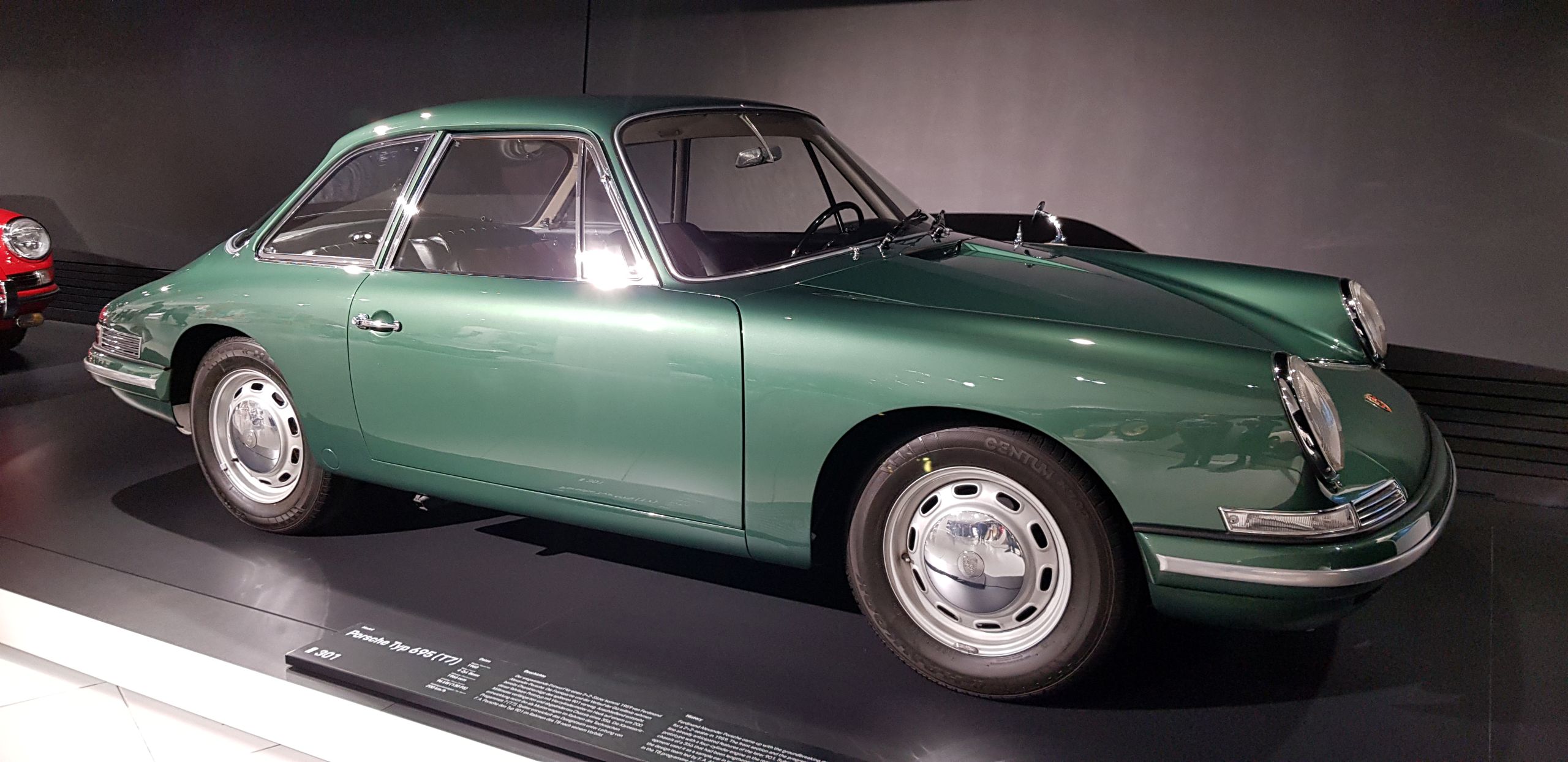
The Porsche Typ 754 T7 (1961)
Also known as the T7 Prototype or 695, this is one of the most important prototypes in Porsche’s history. Built in 1961, the T7 would later evolve into the iconic Porsche 911. While the front end of the T7 strongly resembles the 911, its rear design was distinct, and unlike the 911, the T7 was equipped with four seats.
Developed by Ferdinand Alexander Porsche, the T7 was an evolution of the earlier Porsche 356. It featured a wheelbase that was 100 mm longer than its predecessor, with early designs even stretching the wheelbase by up to 300 mm. This additional length provided better stability and handling, contributing to the vehicle’s performance. The car was capable of reaching a top speed of 200 km/h (124 mph), showcasing its performance potential.
The T7 prototype is a critical step in Porsche’s evolution, bridging the gap between the 356 and the legendary 911 that would define Porsche’s identity for decades to come.
Porsche 550 A Spyder (1956)
The Porsche 550 A Spyder, introduced in 1956, is one of the most iconic and legendary cars in Porsche’s racing history. The displayed Porsche 550 A Spyder is from 1957 and specifically, only 40 units of the 550 A were produced, making it a rare and highly sought-after collector’s item today.
With the introduction of the “A” version in 1956, Porsche took the 550, which had been introduced in 1953, to an entirely new level. The A featured a more advanced, lighter, and stiffer tubular space frame compared to its predecessor’s flat box frame. This redesign reduced the car’s body weight by 27 kg, making the total weight just 530 kg (1,168 lbs). The 550 A Spyder also benefited from a new rear swing axle with a lower pivot point and a front axle stabilizer, which significantly improved its handling.
Under the hood, the Fuhrmann engine was tuned to deliver 135 horsepower, providing the 550 A Spyder with a remarkable combination of lightweight agility and impressive speed. In just five years, the car amassed nearly 400 class victories, making it a dominant force in motorsport.
The 550 A Spyder became a symbol of Porsche’s motorsport success and laid the groundwork for future racing achievements, showcasing the brand’s dedication to performance, engineering, and innovation.

Porsche 356/1 “No. 1” Showcar (1948) – Prototype Exhibit
The Porsche 356/1, often called the Nr. 1 Showcar, is the very first car to wear the Porsche name. Built in the spring of 1948 at Porsche’s Gmünd workshop in Austria, this one-off prototype features an aluminum body hand-formed by Erwin Komenda over a tubular steel frame.
Under the lightweight coachwork sits a 1.1-liter four-cylinder engine producing approximately 35 hp, driving the rear wheels through a four-speed gearbox. Originally designed as a concept car to showcase Ferry Porsche’s vision of a true sports-car marque, it made its public debut at the 1949 Geneva Motor Show.
As the foundation of everything that was to follow, the 356/1 “No. 1” Showcar embodies Porsche’s engineering ethos: light weight, precise handling, and elegant simplicity. It paved the way for the later production 356s and ultimately the iconic 911. Being a unique prototype, it remains one of the museum’s most historically significant exhibits.

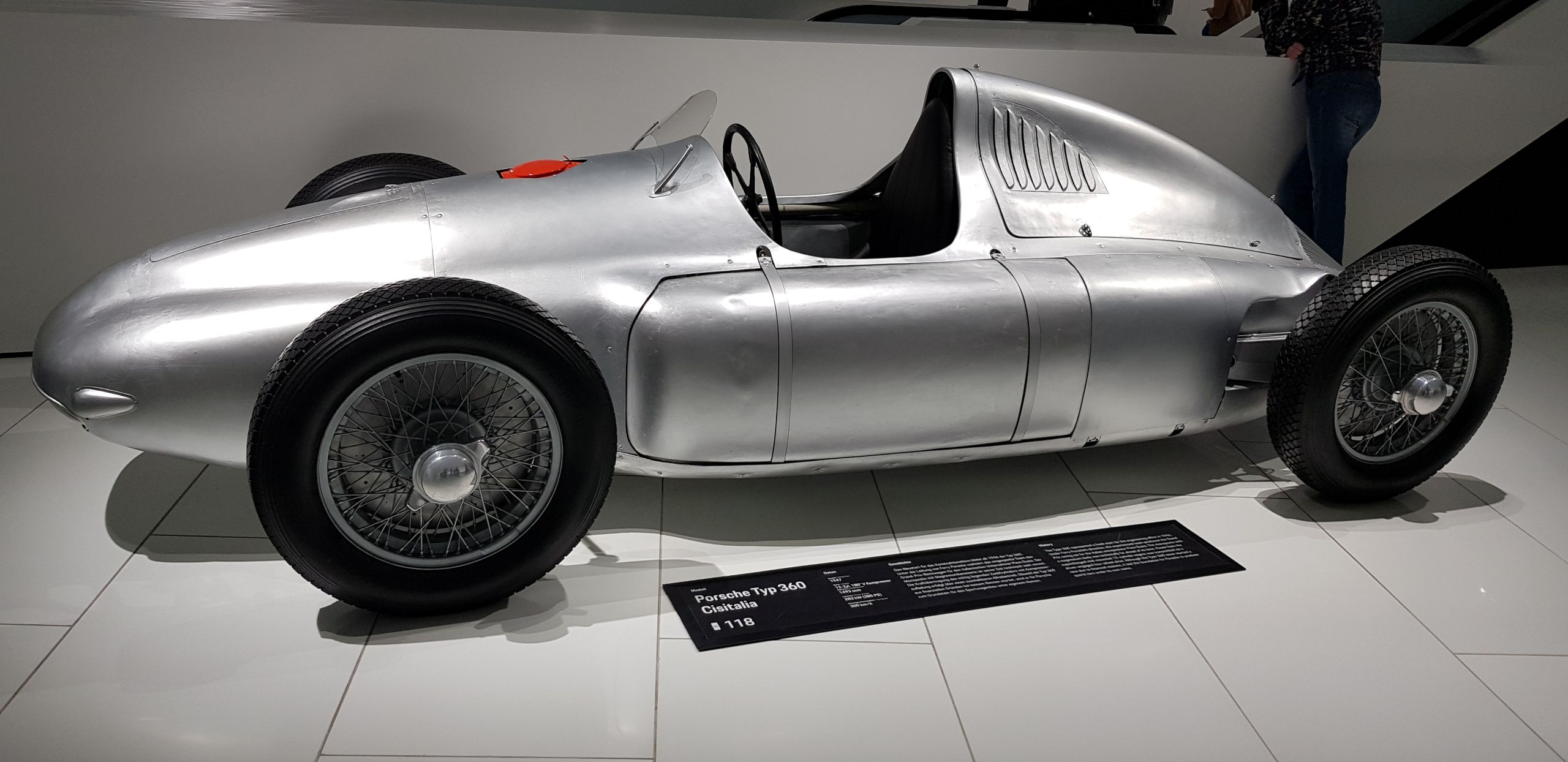
Porsche 360 Cisitalia Prototype (1947)
The Porsche 360 Cisitalia, built in 1947, represents one of Ferry Porsche’s earliest and most ambitious ventures into Grand Prix engineering. The project began on February 2, 1946, when Italian industrialist Piero Dusio—owner of Cisitalia—commissioned the Porsche office in Gmünd, Austria (via Karl Abarth) to develop a Formula 1 racer compliant with the 1950 regulations (1.5 L supercharged or 4.5 L naturally aspirated). Dusio opted for the supercharged 1.5 L
Under Ferry Porsche’s direction, the design team created a mid-engine layout inspired by the Auto Union grand prix cars. At its heart lay a water-cooled, 180° flat-12 with dual overhead camshafts per bank. Two Centric superchargers generated up to 2.8 bar of boost, and feed was managed by Weber twin-choke carburetors. Porsche aimed for 400–450 hp at 10,500 rpm and a top speed around 300 km/h. Uniquely, a selectable front-wheel drive system could be engaged to aid corner exits.
Power was sent through an innovative sequential gearbox developed by engineer Schmid—later known as the Porsche synchronization—mounted between engine and rear axle. The entire assembly was housed within a tubular space-frame chassis of chromoly steel, shod with independent suspension: parallel trailing arms up front and a swing-axle layout at the rear. Covered by lightweight magnesium body panels, the 360 Cisitalia stood as a technological tour de force—yet, due to Cisitalia’s financial collapse, it never raced. Today, the lone prototype on display embodies Porsche’s pioneering spirit and Ferry Porsche’s early mastery of motorsport innovation.
Porsche 911 2.0 (1967)
With the 911, Porsche took a decisive step away from the 356, creating a new sports car that would go on to define the brand’s identity. Introduced in 1964, the early 911 models kept evolving quickly, and by 1967, the 911 2.0 featured numerous improvements over its predecessors. The car was 15 centimeters longer and around six centimeters narrower than the final versions of the 356, offering larger windows and a bigger luggage compartment. Inside, Porsche replaced the simple two-gauge layout with five round instruments, emphasizing the car’s focus on the driver.
Powered by a free-revving 2.0-liter flat-six engine producing 130 horsepower, the 911 2.0 was capable of reaching a top speed of 210 km/h (about 130 mph). Its agile handling, lightweight construction, and mechanical precision captured the spirit of the 1960s sports car era perfectly. Fifty years later, in 2013, Porsche celebrated the legendary 911 by sending a 1967 model on a worldwide tour under the motto “Follow the 911”.

Porsche 906 Carrera 6
The Porsche 906, also known as the Carrera 6, marked a major turning point for the brand. It was the first Porsche designed entirely as a purpose-built race car rather than an adapted road car. Succeeding the 904, the 906 utilized a lightweight tubular spaceframe chassis covered with a hand-laid fiberglass body, reducing weight to just 580 kilograms (around 1,280 pounds). Powered by a naturally aspirated 2.0-liter flat-six engine derived from the production 911, the Carrera 6 delivered 210 horsepower and could reach a top speed of 280 km/h (174 mph).
The design placed a strong emphasis on aerodynamics, with the body extensively tested in wind tunnels – an advanced practice for the era. Thanks to its lightweight construction and superior handling, the 906 was highly competitive in the fiercely contested two-liter sports car class. It achieved significant victories, including a class win at the 1966 24 Hours of Le Mans and numerous triumphs in international endurance racing.
In addition to its racing success, the 906 also featured in popular media: a modified version was used in a German television documentary covering the 1000-kilometer race at the Nürburgring. To make the camera car more identifiable, it was equipped with typical broadcasting station decals. Furthermore, the Carrera 6 was designed with practical modularity in mind—its engine bay could accommodate larger engines, such as Porsche’s flat-eight used in higher racing categories, underscoring its flexibility in competition.

Porsche 914 S (1969)
In 1969, Porsche developed the 914 S as a special high-performance prototype under the leadership of Ferdinand Piëch. Based on the standard 914 platform, the 914 S was fitted with a 2,997 cm³ (183 in³) eight-cylinder boxer engine derived from the Porsche 908 racing car, producing an impressive 221 kW (300 PS / 296 hp). This transformed the modest mid-engine roadster into a true racing machine capable of reaching a top speed of 250 km/h (155 mph).
The chassis was specially tuned for this performance level, featuring reinforced components, titanium coil springs, and competition-grade shock absorbers. Externally, the 914 S could be distinguished by slightly flared wheel arches, a front-mounted air intake for the oil cooler, external tank filler caps, and modified headlight housings for its distinctive dual pop-up headlights.
Only two examples of the 914 S were built. One served primarily as a development and testing vehicle. The second was created as a gift for Ferry Porsche on his 60th birthday, slightly detuned to 260 PS (256 hp) and homologated for road use. Both cars demonstrated the significant performance potential hidden within the 914 chassis, though the 914 S project never reached series production.
The existence of the 914 S also highlights Porsche’s experimental spirit during this period, when the company explored various high-performance derivatives even from relatively modest production models. Although the standard 914 was often seen as an entry-level Porsche, the 914 S hinted at what might have been: a lightweight, mid-engine sports car capable of rivaling much larger and more powerful competitors.

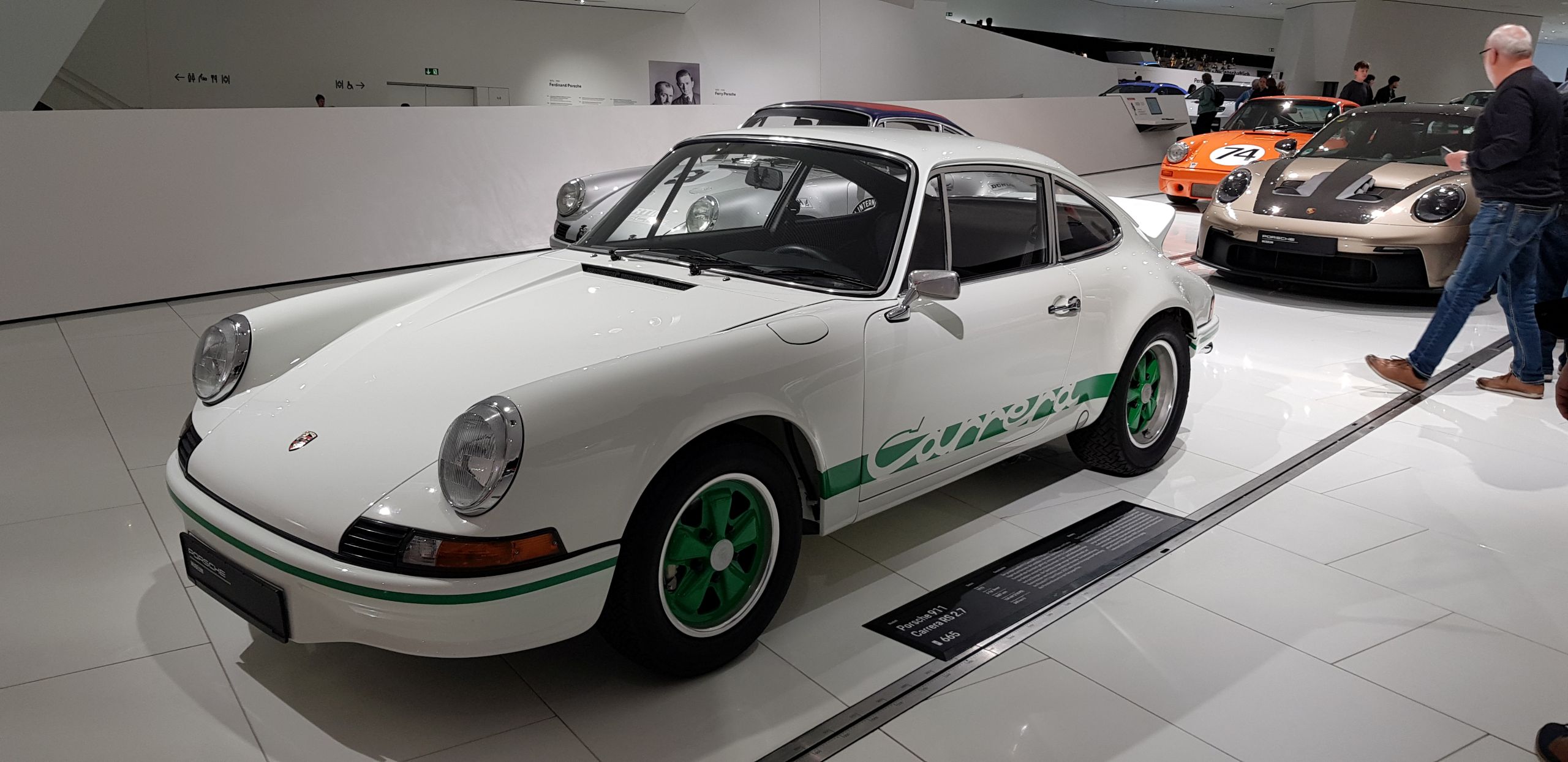
Porsche Carrera RS 2.7 (1973)
The 1973 Porsche 911 Carrera RS 2.7 is a legendary sports car, born from Porsche’s ambition to create a lightweight and high-performance machine for both road and motorsport. Under the development leadership of Ernst Fuhrmann, this model quickly became an icon.
Its naturally aspirated 2,687 cc (164 cu in) flat-six engine produced a formidable 154 kW (210 PS / 207 hp) at 6,300 rpm. This power, combined with a remarkably low weight of just 1,075 kg (2,370 lbs), allowed the Carrera RS 2.7 to accelerate from 0 to 100 km/h (0 to 62 mph) in a mere 5.8 seconds and reach a top speed of an impressive 245 km/h (152 mph).
Visually, the Carrera RS 2.7 was distinctive. It featured wider rear fenders to accommodate larger wheels, a front spoiler to improve aerodynamics, and most notably, the now-iconic “ducktail” rear spoiler. This spoiler wasn’t just for show; it significantly increased downforce on the rear axle, enhancing stability at high speeds.
The “RS” in the name stood for “Rennsport” (racing sport), highlighting the car’s close connection to motorsport. Porsche offered the Carrera RS 2.7 in two versions: the lightweight “Sport” model and the more comfortable “Touring” variant. Both became highly sought after by enthusiasts and collectors alike, solidifying the Carrera RS 2.7’s place as one of the most revered 911 models ever produced. Its blend of exhilarating performance and purposeful design continues to captivate car lovers worldwide.
Porsche 917 LH (1970)
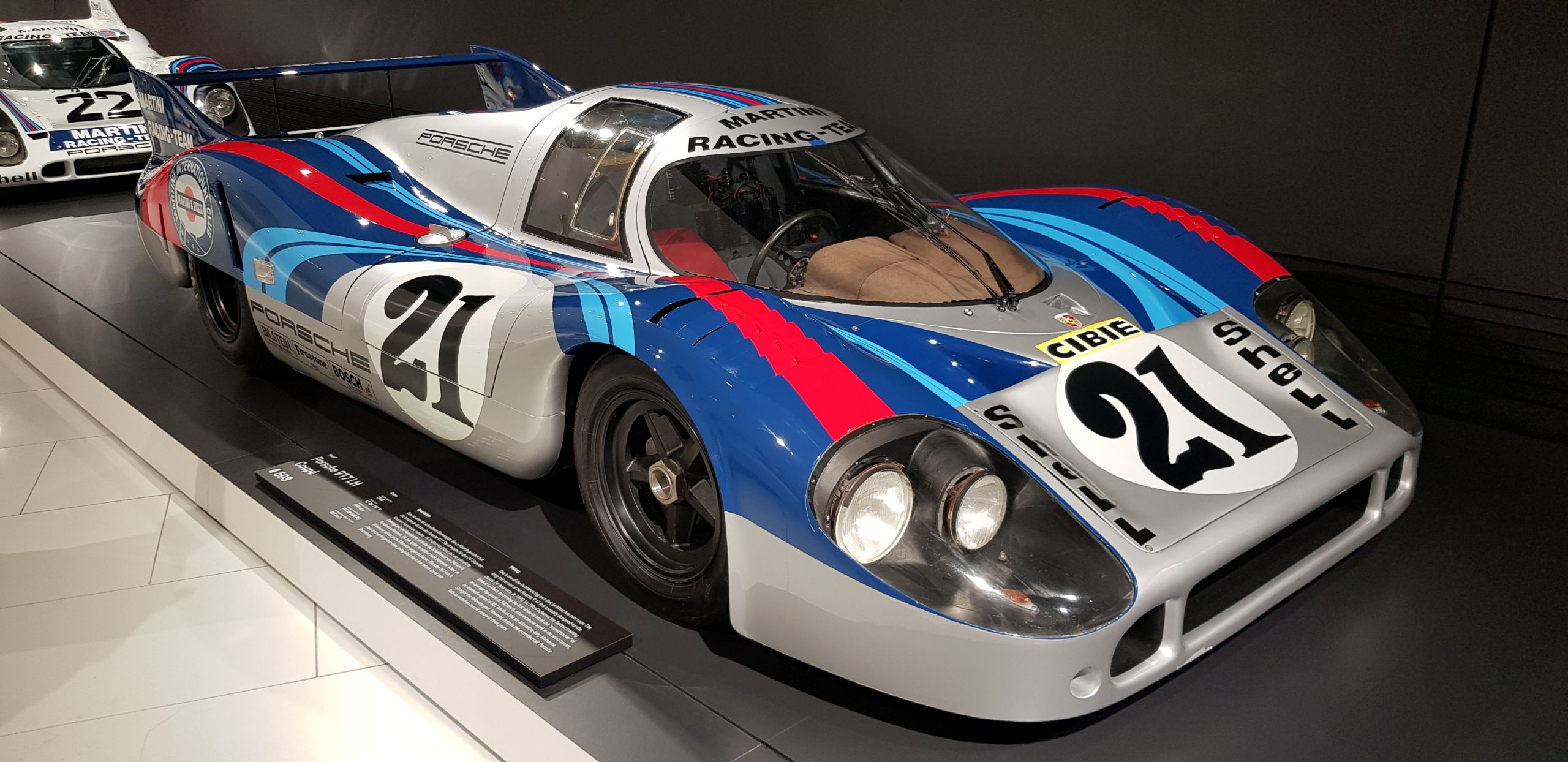
The 1970/1971 Porsche 917 LH (Langheck or Long Tail) Coupé represents a pinnacle of Porsche’s racing prowess in the golden era of endurance racing. This specific car, as indicated by the museum’s information, achieved significant milestones at the legendary 24 Hours of Le Mans.
In 1970, the renowned driver Vic Elford piloted this very 917 LH to the fastest lap time during the test sessions, showcasing the raw speed and aerodynamic efficiency of the long-tail design. This configuration was specifically developed to minimize drag on the long straights of the Circuit de la Sarthe, most notably the famous 6-kilometer (3.7 miles) Mulsanne Straight.
The following year, in 1971, this same Porsche 917 LH, driven by Vic Elford, reached an astonishing top speed of 387 km/h (240 mph) on that very Mulsanne Straight. This incredible velocity underscores the power generated by its formidable engine and the effectiveness of its aerodynamic long-tail bodywork in slicing through the air.
Porsche 917 KH Coupe (1971)
The 1971 Porsche 917 KH (Kurzheck or Short Tail) Coupé on display is a truly unique piece of Porsche racing history. This specific car, chassis number 917-053, holds the distinction of being the only 917 with a lightweight magnesium tubular frame, a testament to Porsche’s relentless pursuit of weight reduction and performance. Its appearance is characterized by the iconic white base with blue and red stripes of Martini Racing.
Powered by a formidable twelve-cylinder boxer engine with a displacement of 4,907 cc (299 cu in), it delivered an impressive output of 442 kW (600 PS / 591 hp). This power propelled the exceptionally light car to a top speed of 360 km/h (224 mph), making it a dominant force on the racetrack.
This very 917 KH, with its special magnesium frame, achieved a historic victory at the 1971 24 Hours of Le Mans. Driven by Helmut Marko and Gijs van Lennep, it not only won the race but also set a distance record that remained unbroken for many years – a remarkable 5,335.313 kilometers (3,315.21 miles) covered at an average speed of 222.304 km/h (138.13 mph).
The “KH” designation signified the short-tail bodywork, which provided better handling and downforce compared to the long-tail version, albeit at a slightly lower top speed. This configuration was particularly well-suited for the more twisty sections of circuits like Le Mans.

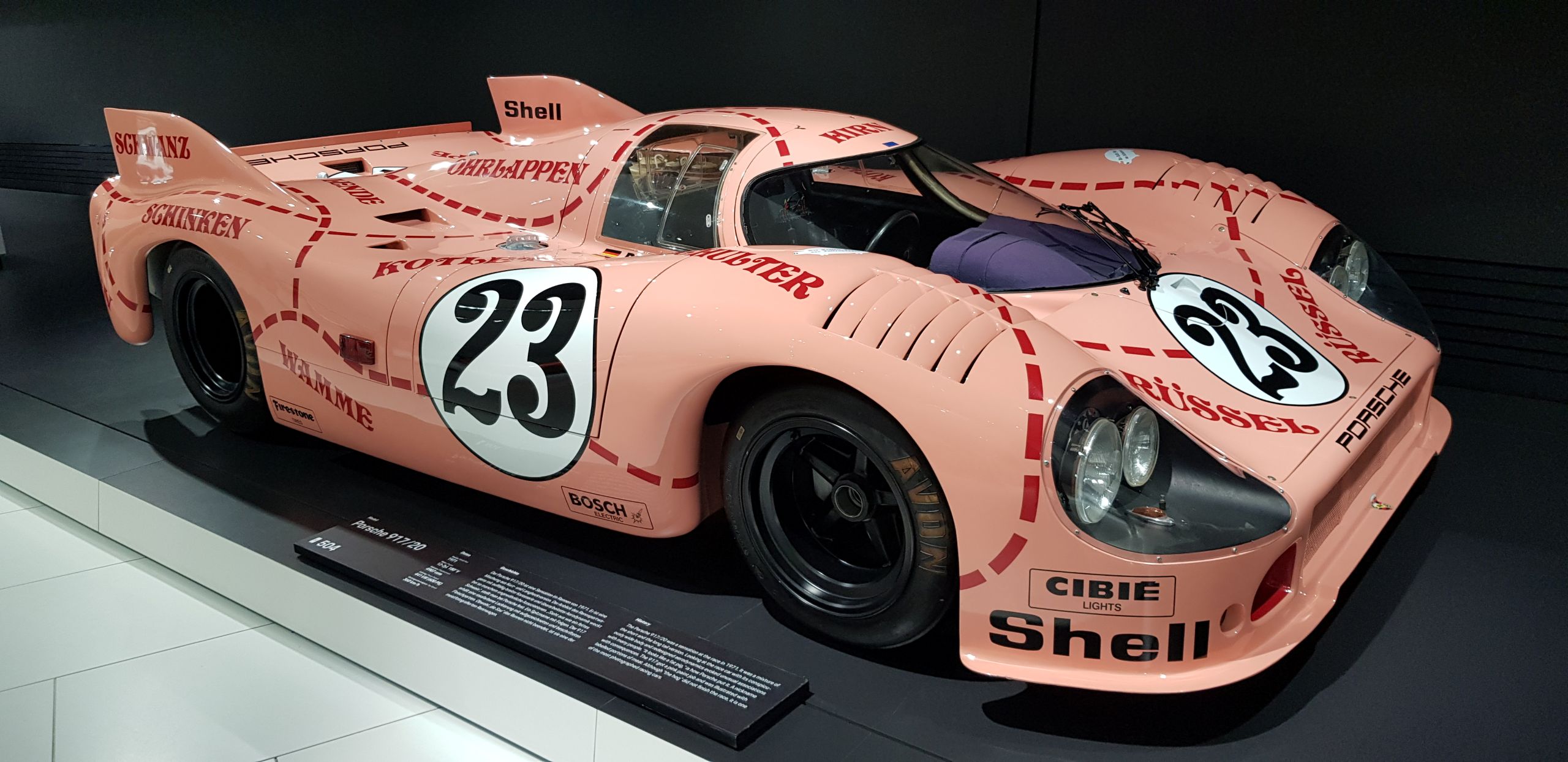
Porsche 917/20 (1971)
The 1971 Porsche 917/20 was a unique and somewhat controversial iteration of the legendary 917 race car. Developed for the 1971 Le Mans race, it was a fusion of the short-tail (KH) and long-tail (LH) versions, aiming to combine the aerodynamic advantages of both.
Its 4,907 cc (299 cu in) twelve-cylinder boxer engine produced a remarkable 441 kW (600 PS / 592 hp), allowing it to reach a top speed of approximately 360 km/h (224 mph).
The 917/20’s most striking feature was its radically redesigned, wide bodywork, which led to its rather unflattering nickname: “Pink Pig” or “Dicke Berta” (Fat Berta) due to its broad proportions and the pink paint job with butcher-style markings indicating different body sections.
Despite its unconventional appearance, the 917/20 proved to be fast and stable during practice for the 1971 Le Mans race. Driven by Reinhold Joest and Willi Kauhsen, it even set the fastest lap time during the pre-race tests. However, in the race itself, the “Pink Pig” had to retire due to an accident.
Porsche 911 Carrera RSR (1972)
Developed with its roots in the 1972 Carrera RS, the Porsche 911 Carrera RSR was a pure racing machine. The “RSR” designation stood for “Rennsport Rennwagen” (racing sport race car), clearly indicating its intended purpose.
Its naturally aspirated 2,992 cc (183 cu in) flat-six engine produced a potent 228 kW (310 PS / 306 hp). This power, combined with a significantly reduced weight, made it exceptionally competitive. The car achieved a top speed of around 270 km/h (168 mph), depending on the gearing.
This specific 911 Carrera RSR saw action in various significant races. In 1972, it participated in the challenging Tour de Corse (Rallye Korsika). The following year, 1973, brought considerable success, including an overall victory at the prestigious 24 Hours of Daytona. The car also achieved a commendable third place at the Targa Florio in May. Furthermore, in July 1973, it competed at the legendary 24 Hours of Le Mans, powered by a 2.8-liter engine.

Porsche 911 Carrera RSR 3.0 (1974)
The 1974 Porsche 911 Carrera RSR 3.0 represented a further evolution of Porsche’s dominant racing 911. Building on the success of the earlier RSR models, the 3.0-liter version offered increased power for the 1974 motorsport season.
Its naturally aspirated, air-cooled 2,993 cc (183 cu in) flat-six engine now produced an even more impressive 243 kW (330 PS / 325 hp). This additional power, combined with its lightweight construction and the powerful braking system adopted from the Porsche 917, allowed the RSR 3.0 to achieve a top speed of approximately 280 km/h (174 mph), depending on the track and gearing.
Visually, the 1974 Carrera RSR 3.0 retained the wide bodywork and aerodynamic elements of its predecessors, including the prominent front spoiler and the large rear wing, often referred to as the “whale tail.” These features were crucial for generating downforce and ensuring stability at high speeds.
The 1974 season saw the Carrera RSR 3.0 achieve significant success in Group 4 of various international racing series. Its reliability and formidable performance made it a popular choice for both factory teams and private entrants. The larger 3.0-liter engine provided improved torque and drivability, further enhancing its competitiveness in its class.

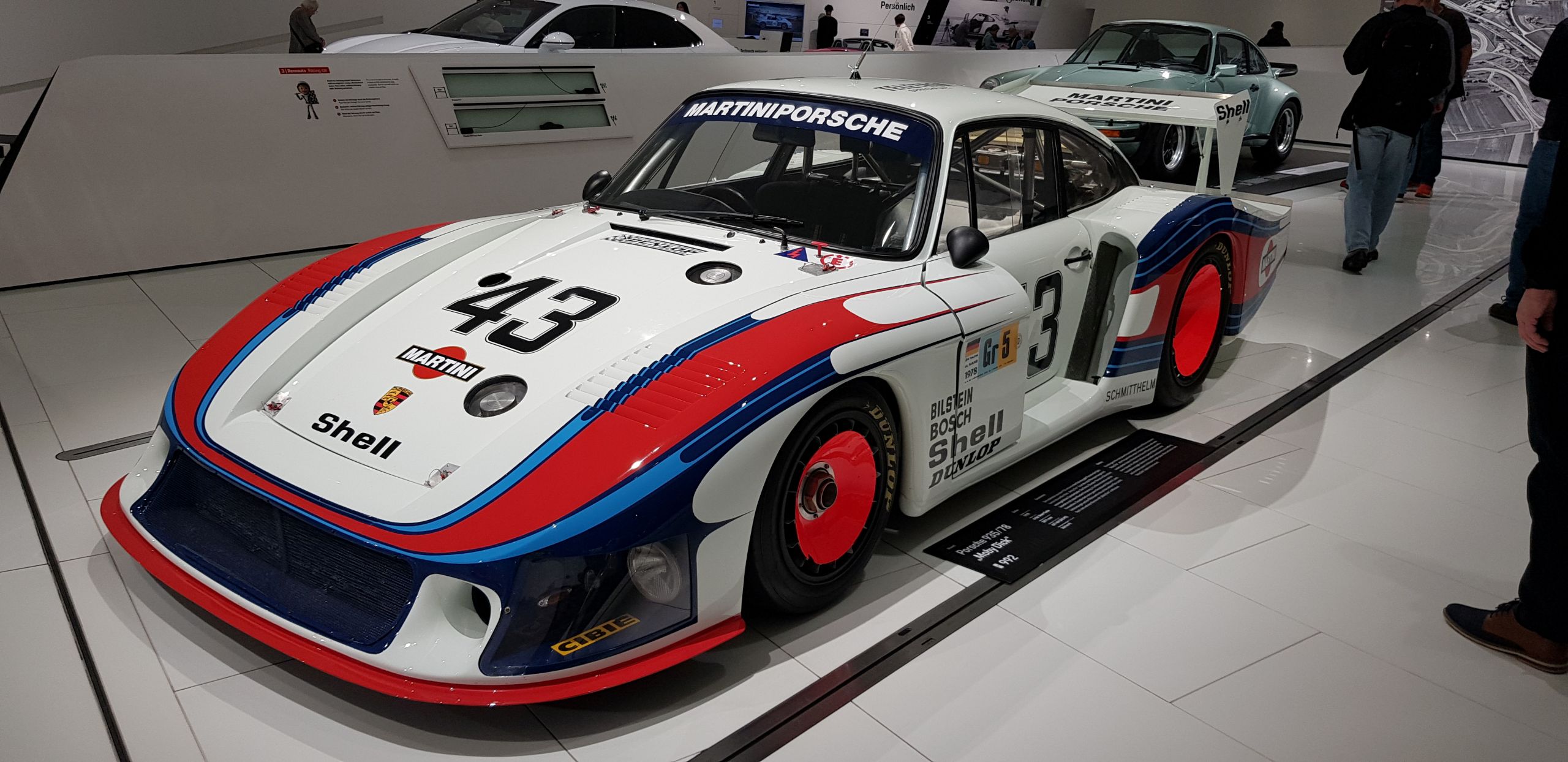
Porsche 935/78 Moby Dick (1978)
The 1978 Porsche 935/78, famously nicknamed “Moby Dick” due to its elongated, whale-like bodywork, was a radical evolution of the successful 935 race car. Developed specifically for high-speed tracks like Le Mans, it pushed aerodynamic boundaries and was the first Porsche race car to feature water-cooled cylinder heads.
Its potent 3,211 cc (196 cu in) twin-turbocharged flat-six engine delivered an impressive 621 kW (845 PS / 834 hp), making it one of the most powerful cars of its era. This immense power allowed “Moby Dick” to reach a staggering top speed of 366 km/h (227 mph).
The most distinctive feature of the 935/78 was its extensively modified aerodynamics. The long tail, low roofline, and enclosed rear wheels were all designed to minimize drag and maximize stability at extreme speeds. Only one example of this highly specialized machine was ever built.
In its racing debut at the 1978 6 Hours of Silverstone, “Moby Dick” secured a victory. However, at the 24 Hours of Le Mans later that year, despite its incredible speed, it faced reliability issues and ultimately did not finish.
Despite its limited racing career and single victory, the Porsche 935/78 “Moby Dick” has become a legendary and iconic race car. Its extreme design and immense power, along with its pioneering water-cooled cylinder heads, perfectly represent Porsche’s engineering prowess and their willingness to push the limits in pursuit of victory.
Porsche 917/10 (1972)
The 1972 Porsche 917/10 Spyder was Porsche’s formidable answer to the high-powered competition in the North American Can-Am series. After their dominant success in the World Sportscar Championship in previous years, Porsche took on this new challenge by developing an open-top version of their legendary 917.
Powering this beast was a 4,999 cc (305 cu in) 180-degree flat-twelve engine equipped with two turbochargers. This advanced forced induction technology allowed the engine to unleash an astounding 735 kW (1,000 PS / 986 hp), pushing the lightweight Spyder to speeds of around 360 km/h (224 mph).
Porsche’s expertise in turbocharging for racing engines proved to be a game-changer in the Can-Am series. In 1972, with George Follmer behind the wheel of a 917/10, Porsche triumphed in six out of the nine rounds, securing the championship title against the backdrop of powerful, large-displacement American competitors.
The 917/10 Spyder not only demonstrated Porsche’s engineering prowess in adapting to new racing environments but also highlighted the effectiveness of turbocharging in achieving dominant performance. Its resounding success in the demanding Can-Am series further cemented the 917’s iconic status in the world of motorsport.

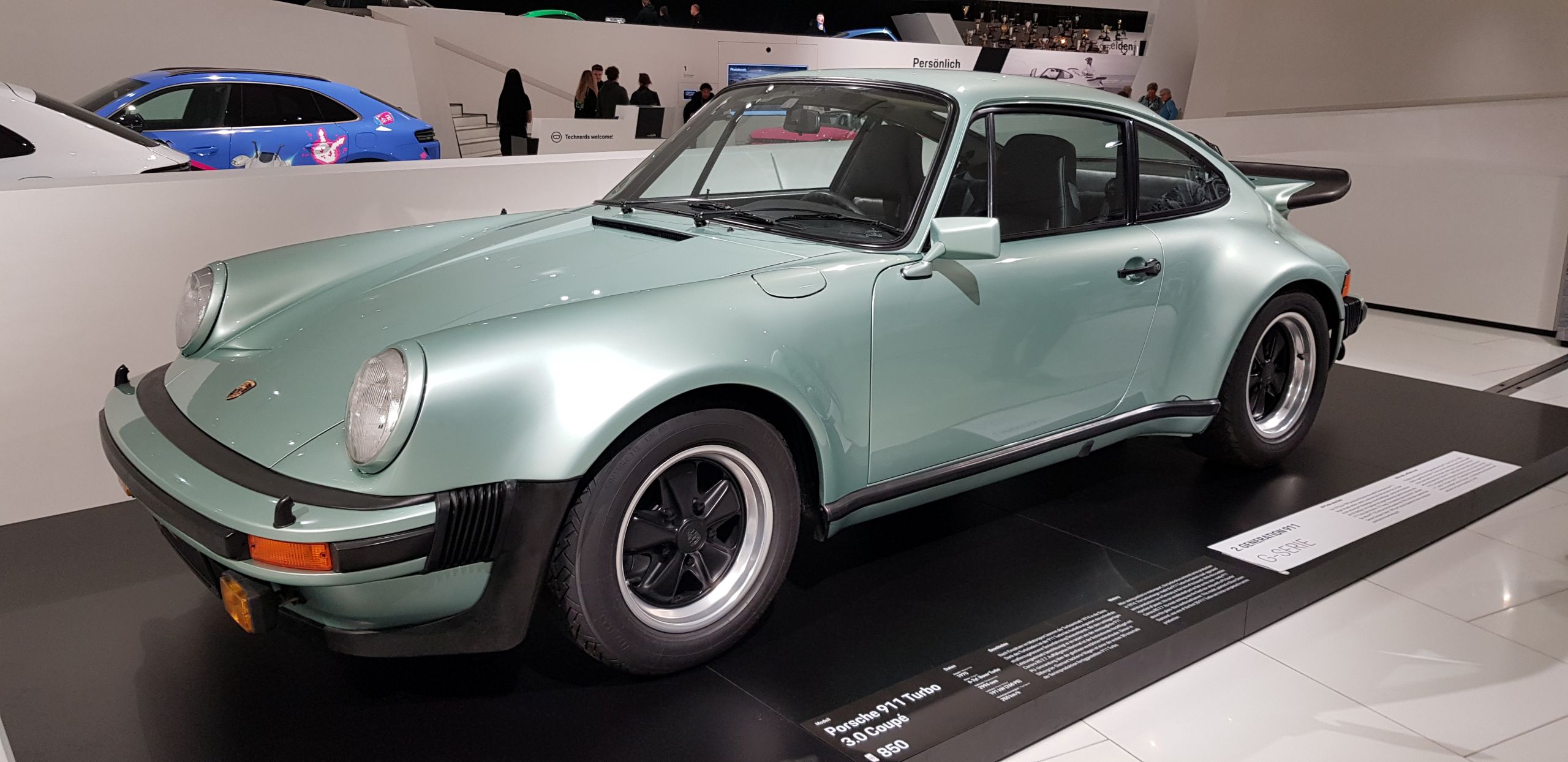
Porsche 911 Carrera Turbo 3.0 (1975)
The 1975 Porsche 911 Carrera Turbo 3.0 marked a significant turning point in the history of the 911, introducing turbocharging to Porsche’s iconic sports car lineup. This model wasn’t just about raw power; it represented a new era of performance and a blend of everyday usability with exhilarating speed. Significantly, it also received its own internal designation, 930, setting it apart from the other “standard” 911 models of the time.
Its 2,994 cc (183 cu in) single-turbocharged flat-six engine produced a then-impressive 191 kW (260 PS / 256 hp). This power was delivered with a noticeable “turbo lag,” a characteristic of early turbocharged engines. Once the boost kicked in, however, the acceleration was so sudden and forceful that the car earned the somewhat notorious nickname “Widowmaker“, as some drivers found its abrupt power delivery challenging to handle. The top speed was around 250 km/h (155 mph).
Visually, the 911 Turbo 3.0 (or 930) was distinguished by its wider rear fenders, a prominent “whale tail” rear spoiler (although earlier versions had a smaller “tea tray” spoiler), and often by its Fuchs alloy wheels. These elements not only contributed to the car’s aggressive stance but also improved aerodynamics and stability.
The introduction of turbocharging to the 911 was a bold move by Porsche, and the 930 paved the way for decades of high-performance turbocharged 911 models that continue to define the brand’s sporting heritage. It successfully bridged the gap between a refined sports car and a potent performance machine, albeit one that demanded respect from its driver and established a new, more exclusive identity within the 911 family.
Porsche 959 Paris-Dakar (1986)
The 1986 Porsche 959 Dakar represents a remarkable fusion of high-performance sports car technology and rugged off-road capability. Originally developed as a Group B rally car, the 959 evolved into a technological tour de force, and its participation in the grueling Paris-Dakar Rally cemented its legendary status.
Powering the 959 Dakar was a 2.85-liter (174 cu in) twin-turbocharged flat-six engine, derived from the road-going 959. However, in its rally specification, the engine’s output was reduced to around 294 kW (400 PS / 395 hp), primarily due to the lower quality of fuel available during the demanding desert race. The advanced all-wheel-drive system, known as Porsche-Steuer Kupplung (PSK), allowed for variable torque distribution between the front and rear axles, crucial for optimal traction in slippery conditions.
The 959 Dakar featured a raised ride height, reinforced suspension components, and special off-road tires to tackle the harsh environment of the desert rally. Its lightweight composite body panels also helped to keep the overall weight down.
In the 1986 Paris-Dakar Rally, Porsche entered three 959s, and they achieved a resounding victory with René Metge and Dominique Lemoyne taking the overall win. Another 959, driven by Jacky Ickx and Claude Brasseur, finished second, demonstrating the car’s exceptional performance and reliability in one of the world’s toughest motorsport events.

Porsche 959 S (1987)
The Porsche 959 S (Sport) represented an even more extreme and performance-focused version of the already groundbreaking 959, and was even rarer, with only 29 examples sold to customers. Aimed at enthusiasts seeking the ultimate driving experience, the 959 S boasted significantly increased power and reduced weight compared to the standard model.
This exclusive variant featured larger turbochargers operating at a higher boost pressure, resulting in a power output of 515 PS (379 kW / 508 hp), a substantial increase over the base model’s 450 PS. This, combined with the deletion of comfort features like automatic climate control, central locking, electric windows, the right-side exterior mirror, and the rear seats for weight reduction purposes, made for truly breathtaking performance. The 959 S could accelerate from 0 to 100 km/h (0 to 62 mph) in a mere 3.7 seconds and reach a top speed of around 339 km/h (211 mph), making it one of the fastest road-legal cars of its time. Furthermore, the 959 S did not feature the standard model’s ride-height control system.
Like the standard 959, the S version retained Porsche’s sophisticated all-wheel-drive system (PSK) and anti-lock brakes. However, the “Sport” designation clearly emphasized its performance-oriented nature through its increased power, reduced weight, and omission of certain comfort and convenience features.
The Porsche 959 S represented the absolute pinnacle of Porsche’s technological capabilities in the late 1980s, pushing the boundaries of what was considered possible for a road-going sports car and achieving legendary status due to its rarity and exceptional performance.

McLaren TAG Porsche Formel 1
Commissioned by the TAG Group, Porsche developed an engine that would leave a permanent mark on Formula One history. What emerged was a 1.5-liter V6 twin-turbocharged unit — tiny in displacement, massive in impact. With just 1,499 cc (91.5 cu in), it delivered a staggering 625 kW (850 PS / 838 hp) and propelled the McLaren F1 cars to top speeds of 350 km/h (217 mph).
Between 1983 and 1987, this compact powerhouse helped secure three World Championship titles and 25 Grand Prix victories, driven by legends like Alain Prost and Niki Lauda. It wasn’t just about raw speed — the engine was remarkably reliable, a rare trait in the turbo era when power outputs sometimes exceeded 1,000 hp in qualifying trim.

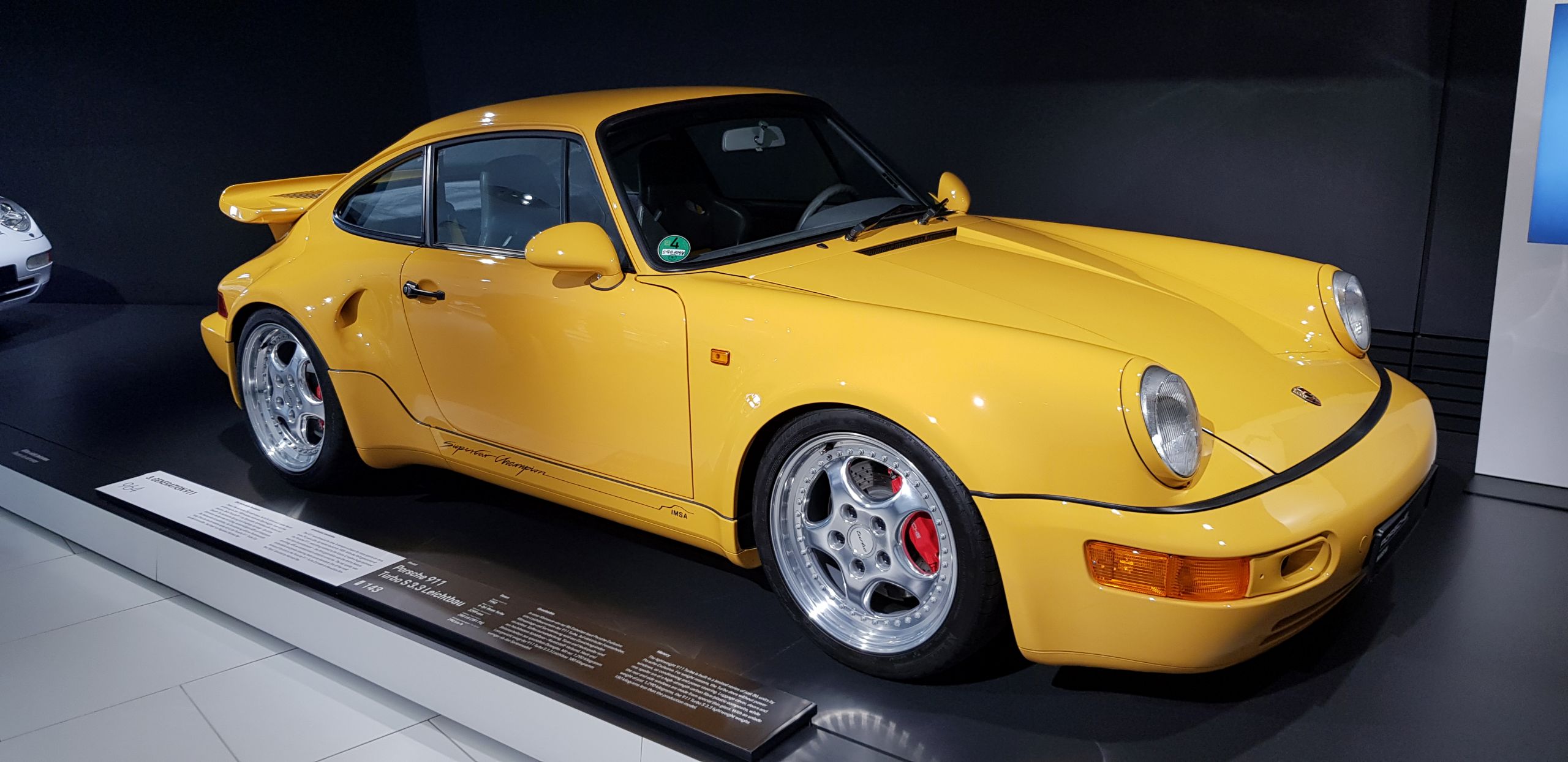
Porsche 911 Turbo S 3.3 Leichtbau (1992)
The 911 Turbo S 3.3 Leichtbau was Porsche’s answer to those who believed the standard 964 Turbo wasn’t hardcore enough. Built in a limited run of just 86 units, this special model was assembled by Porsche’s Exclusive department and focused on extreme weight savings and sharper performance. The idea was to create a purist’s driving machine that echoed the spirit of the original 911 lightweight models and motorsport.
The weight was reduced by roughly 180 kilograms (397 lbs) compared to the standard Turbo, thanks to the removal of rear seats, air conditioning, sound insulation, and power steering. In their place came lightweight bucket seats, thinner glass, an aluminium bonnet, and various carbon-fibre panels. The body also featured a fixed rear wing and integrated air ducts behind the doors – both functional and visually striking.
Power came from the turbocharged 3.3-litre flat-six engine, which in the Leichtbau produced 381 PS (375 hp) – slightly more than the standard Turbo. Combined with the reduced weight, the result was a 0–100 km/h (0–62 mph) sprint in around 4.7 seconds and track performance that rivalled race-prepped machines.
The Leichtbau wasn’t about luxury or comfort. It was about feel, feedback, and the raw mechanical thrill of driving. And while it might have been street legal, it felt most at home on a circuit. Today, it remains one of the rarest and most coveted 964-generation 911s ever built.
Porsche 911 GT3 Cup (2009)
Built for privateers and one-make racing series like the Porsche Carrera Cup and the Porsche Supercup, the 2009 911 GT3 Cup was based on the 997.2-generation 911 and brought a new level of performance to customer racing. Under its lightweight bodywork was a naturally aspirated 3.8-litre flat-six engine, derived from the road-going GT3 but thoroughly reworked for motorsport use. It produced 450 PS (444 hp) and revved freely to 8,500 rpm, offering a visceral soundtrack and razor-sharp throttle response.
Compared to the road car, the Cup version featured a stripped-down interior, a welded-in roll cage, a single racing seat with six-point harness, and an FIA-spec fire suppression system. Weight was trimmed to around 1,200 kg (2,645 lbs), with carbon-fibre panels and lightweight polycarbonate windows further helping shed unnecessary mass.
The GT3 Cup ran on a six-speed sequential gearbox with dog-ring engagement, allowing flat-upshifts without the clutch. The chassis was stiffened, the suspension fully adjustable, and the brakes replaced with race-spec components including massive steel discs and improved cooling ducts.

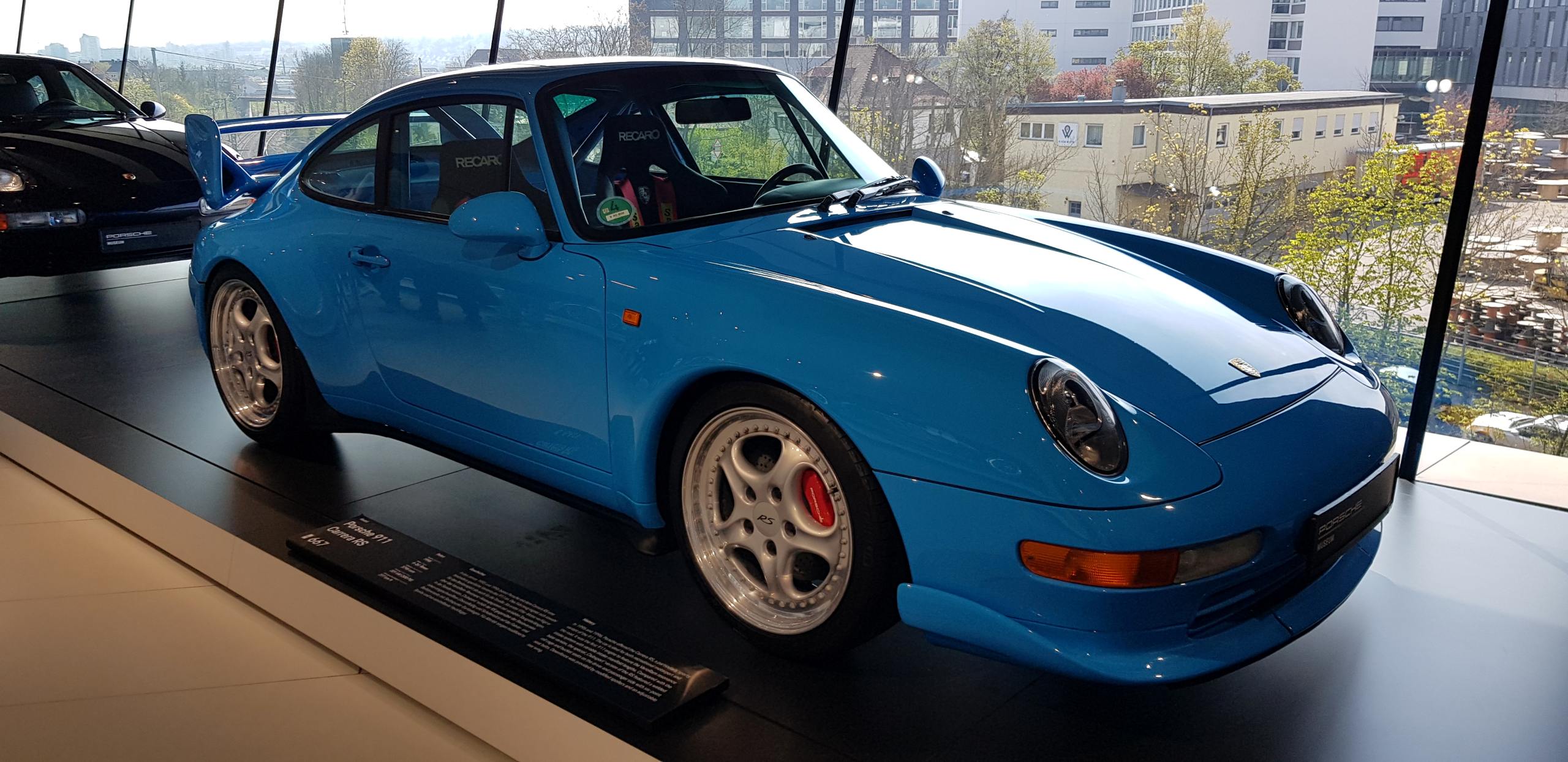
Porsche 911 Carrera RS 3.8 Clubsport (1995)
As the ultimate road-legal track weapon of the air-cooled era, the 993-generation Carrera RS 3.8 Clubsport occupies a special place in Porsche history. Introduced in 1995, it was a homologation special developed for international GT racing, with only 1,104 Carrera RS 3.8s built — and far fewer in hardcore Clubsport specification.
Power came from a naturally aspirated 3.8-litre flat-six engine producing 300 PS (296 hp), equipped with lightweight forged pistons, a dual-mass flywheel, and a specially tuned intake and exhaust system. Power was sent to the rear wheels through a short-ratio G50/31 six-speed manual gearbox, with a limited-slip differential ensuring optimal traction. With a kerb weight of just 1,280 kg (2,822 lbs) in Clubsport trim, performance was razor-sharp: 0–100 km/h (0–62 mph) in around 4.7 seconds, and a top speed of over 270 km/h (168 mph).
The Clubsport package turned the already focused RS into a no-compromise driving machine. It added a fully welded roll cage, a single Recaro racing seat with harness, battery cut-off switch, fire extinguisher, and a stripped-out interior with no sound insulation or comfort features. Even the airbags were deleted.
The suspension was lowered and stiffened, and the car sat on wider track-ready wheels and tyres. Its bodywork included a fixed “whale tail” rear wing and more aggressive front and rear spoilers to improve aerodynamic stability at high speed.
Porsche 911 GT3 Cup 30 Years (2021)
Marking three decades of Porsche’s premier one-make racing series, the 2021 911 GT3 Cup “30 Years of Supercup” edition pays tribute to the championship that has served as a proving ground for countless motorsport talents since 1993.
Based on the 992-generation 911 and developed in Weissach, this unique car retains the core racing attributes of the customer Cup cars: a naturally aspirated 4.0-litre flat-six producing 510 PS (503 hp) at 8,400 rpm and 470 Nm (347 lb-ft) of torque, channelled through a six-speed sequential racing gearbox with paddle shift.
Weighing just 1,260 kg (2,778 lbs), the car features extensive aerodynamic refinements including a swan-neck mounted rear wing, reworked front splitter, and optimised underbody airflow for improved downforce. However, its visual and symbolic standout feature is the commemorative livery and anniversary detailing, distinguishing it as the sole factory-built “30 Years of Supercup” edition.
Inside, the cockpit is stripped for performance: a welded roll cage, racing bucket seat with six-point harness, FIA-compliant fire system, and a fully digital race display co-developed with Cosworth dominate the driver’s environment.
As a one-off tribute, this particular GT3 Cup car is more than just a machine — it is a rolling milestone celebrating Porsche’s deep and ongoing legacy in international customer racing.

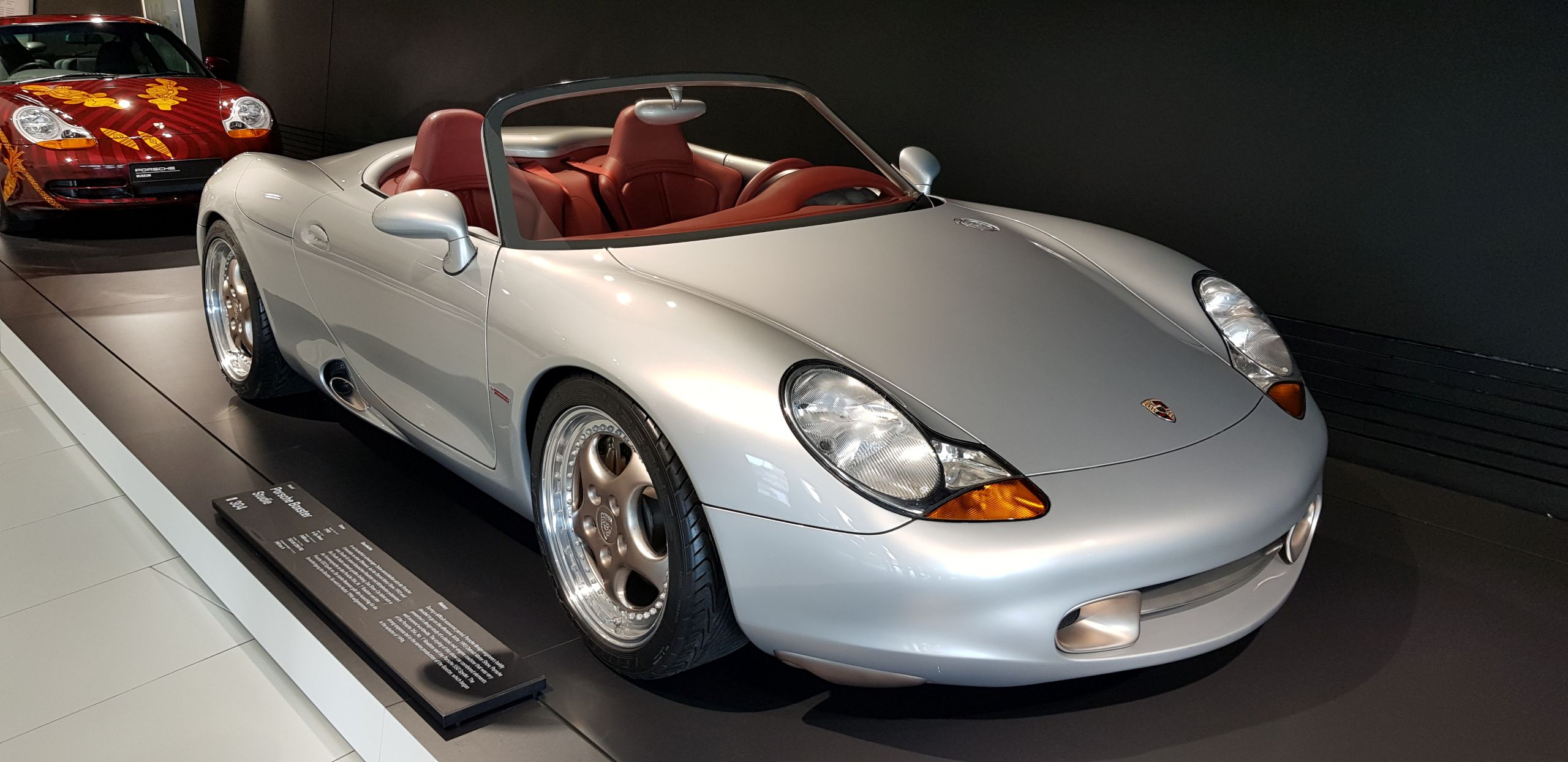
Porsche-Boxster-Studie-Concept (1993)
Unveiled at the 1993 Detroit Auto Show, the Porsche Boxster Concept marked a pivotal moment for the brand—both stylistically and strategically. At a time when Porsche was facing financial uncertainty and a declining model lineup, the mid-engined roadster study offered a bold new direction rooted in heritage, yet aimed squarely at the future.
Designed by Grant Larson under the direction of Harm Lagaaij, the Boxster Concept took clear inspiration from the iconic 550 Spyder and 718 RS 60. With its low-slung body, minimalist interior, centre-exit exhaust, and retro-styled front and rear ends, the concept rekindled the spirit of Porsche’s early racing barchettas while presenting a modern interpretation that excited both press and public alike.
Unlike many concept cars, the Boxster study closely previewed a production model. Just three years later, in 1996, the Porsche Boxster (986) would arrive on the market with a design remarkably faithful to the show car—an uncommon practice at the time. While some details had to be toned down for production (such as the more aggressive front fascia and stripped-back interior), the core proportions and styling language remained largely intact.
The concept car itself, however, is a unique prototype and not merely a non-functional showpiece. Underneath the striking bodywork is a fully operational powertrain and chassis, featuring a naturally aspirated flat-six engine mounted ahead of the rear axle—previewing the mid-engine layout that would define the Boxster and Cayman lines for decades to come.
Beyond its immediate influence, the Boxster Concept is widely credited with saving the Porsche brand. It laid the foundation for a new, more accessible model that brought thousands of new customers to the marque, while preserving the purity of the driving experience Porsche was known for. It also helped fund the continued development of the 911 and future icons.
Mercedes-Benz-E500-Saloon (1995)
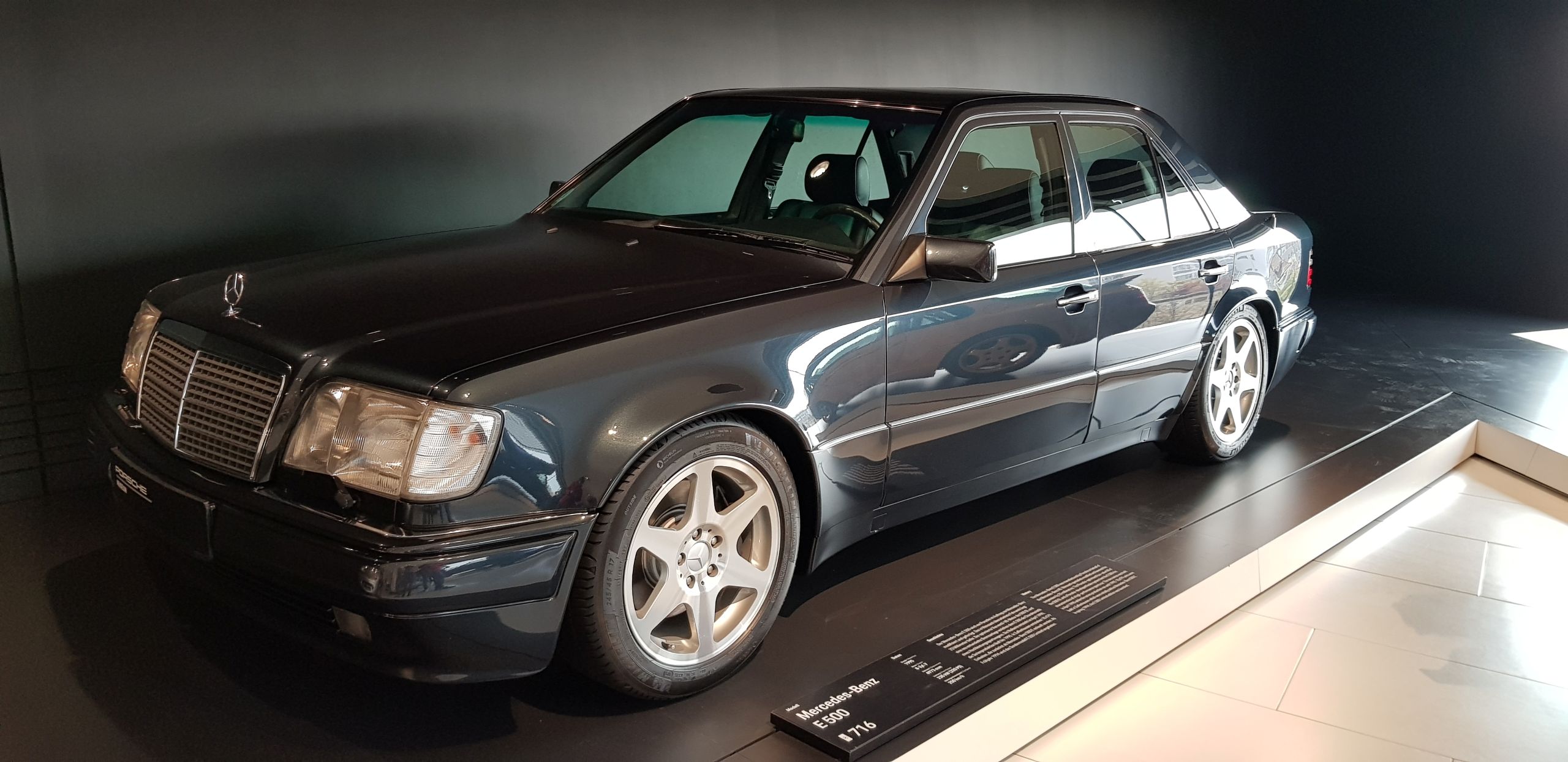
At first glance, the 1995 Mercedes-Benz E500 might appear to be just another discreet luxury saloon from Stuttgart. But behind its unassuming silhouette lies one of the most fascinating collaborations in German automotive history—a high-performance sedan born from the unlikely partnership between Mercedes-Benz and Porsche.
Originally launched as the 500 E in 1991 and later renamed E500 in 1993 after the W124 facelift, this autobahn missile was engineered to combine the elegance and comfort of a Mercedes with the dynamic soul of a Porsche. The car was developed at a time when Porsche was seeking contract work to stabilise its finances. Mercedes-Benz, on the other hand, needed outside expertise to fit a large V8 into the relatively compact W124 chassis while maintaining driveability and refinement.
Porsche’s contribution was far more than advisory. The 5.0-litre naturally aspirated M119 V8 engine—derived from the SL and S-Class—was shoehorned into the W124 body with extensive chassis modifications to handle the 320 PS (316 hp / 235 kW) and 480 Nm (354 lb-ft) of torque. Porsche reworked the suspension, brakes, and geometry, ensuring the E500 offered not just brute power but true handling prowess. The car accelerated from 0 to 100 km/h (62 mph) in just 5.9 seconds—supercar pace for its day.
But perhaps the most fascinating part of the story is the production process itself. Because the modifications were too complex for Mercedes’ standard assembly lines, each 500 E was hand-built at Porsche’s Roessle-Bau plant in Zuffenhausen. The unfinished W124 bodies were shipped from Mercedes’ Sindelfingen factory to Porsche, where they were extensively modified and assembled, before being sent back for final paint and finishing. Each car took 18 days to complete—an astonishing figure for a production saloon.
Subtle flared arches, wider track, and discreet badging were the only visual hints to the car’s true capabilities. It remained the ultimate Q-car—able to cruise comfortably across continents in supreme luxury, or devour twisty roads with a composure and pace unexpected from such a conservative-looking machine.
By the time production ended in 1995, around 10,479 examples had been built. The E500 remains a cult classic and a symbol of what happens when two of Germany’s most storied marques combine their best talents. It was not just fast—it was engineered with surgical precision, wrapped in understatement, and built with Porsche hands.
Porsche 911 Carrera Coupe Biggibilla (1998)
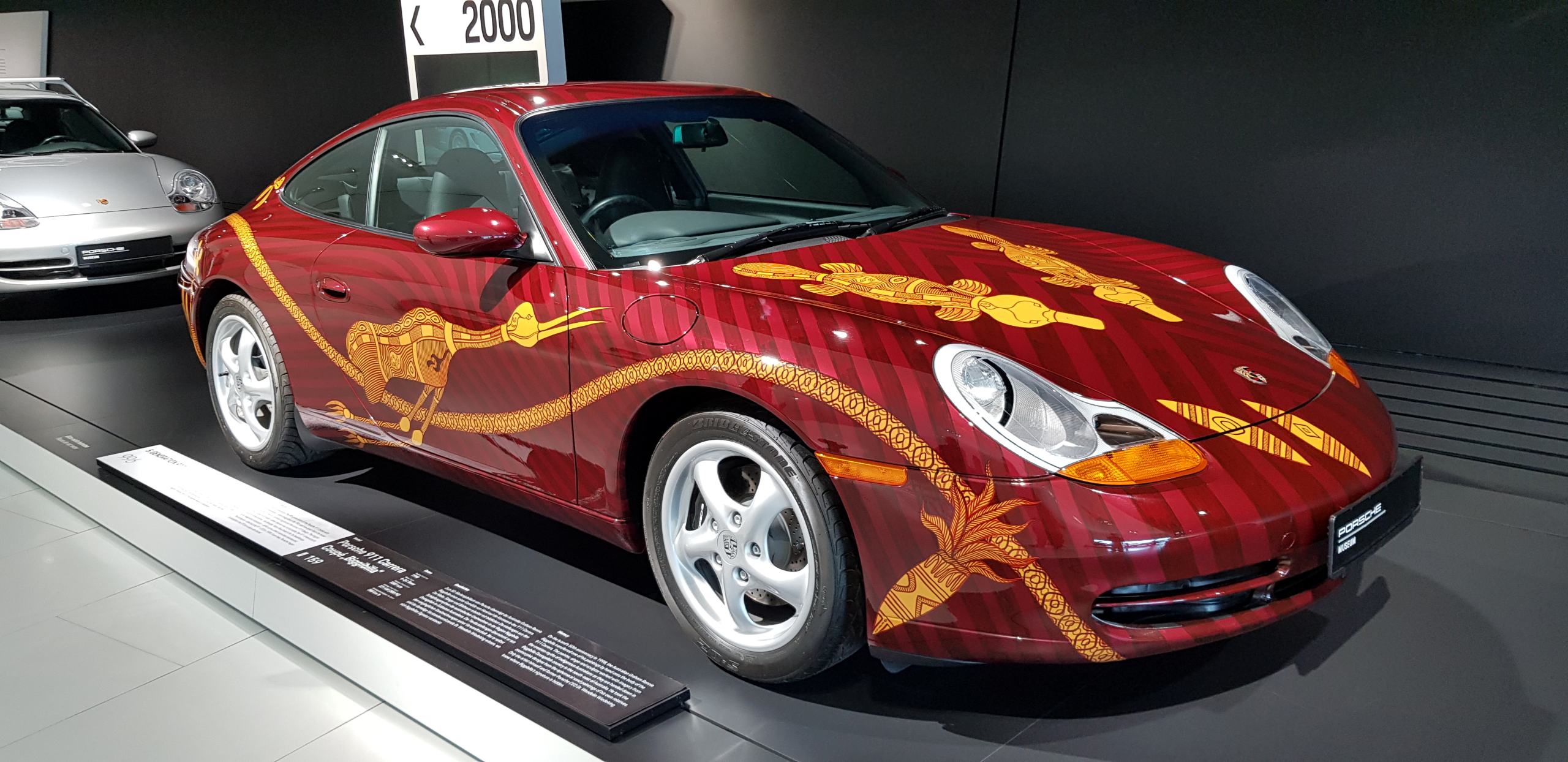
The 1998 Porsche 911 Carrera Coupé “Biggibilla” is a one-of-a-kind art car based on the 996-generation 911 – the first iteration of the iconic model to feature a water-cooled flat-six engine. This unique vehicle was hand-painted by Aboriginal Australian artist Graham Rennie, known as Biggibilla, which means “echidna” in his native language.
His artwork transforms the sleek lines of the 911 into a vivid canvas of storytelling. The patterns and symbols painted across the car draw on ancient traditions and Dreamtime narratives, expressing cultural heritage through automotive form. Mechanically, the car remains a stock 996 Carrera, but its appearance makes it truly singular.
Porsche GT1 Nr. 25 (1998)
The 1998 Porsche 911 GT1 (No. 25) represents the pinnacle of Porsche’s pursuit of endurance racing glory in the late 1990s. Although it bears the 911 name, the GT1-98 is a purpose-built race car with virtually no shared parts with the production 911 – a mid-engined prototype in GT clothing, designed to comply with FIA GT1 class regulations.
Unlike earlier GT1 versions which retained some elements of the 911’s roadgoing architecture, the 1998 iteration featured a full carbon fibre monocoque chassis – a first for Porsche at the time – and an aerodynamically refined body developed with the wind tunnel expertise gathered through years of Le Mans competition. It was powered by a twin-turbocharged 3.2-litre flat-six engine producing around 550 PS (542 bhp / 404 kW), paired with a six-speed sequential gearbox.
The No. 25 car was one of two factory entries at the 1998 24 Hours of Le Mans, competing alongside its sister car, No. 26. While No. 25 ran strongly during the race, it ultimately finished second overall, just behind No. 26 – securing a historic 1-2 finish for Porsche on the marque’s 50th anniversary. The victory was made even sweeter as it came in Porsche’s final year of factory-backed GT1 competition, before the category was retired.

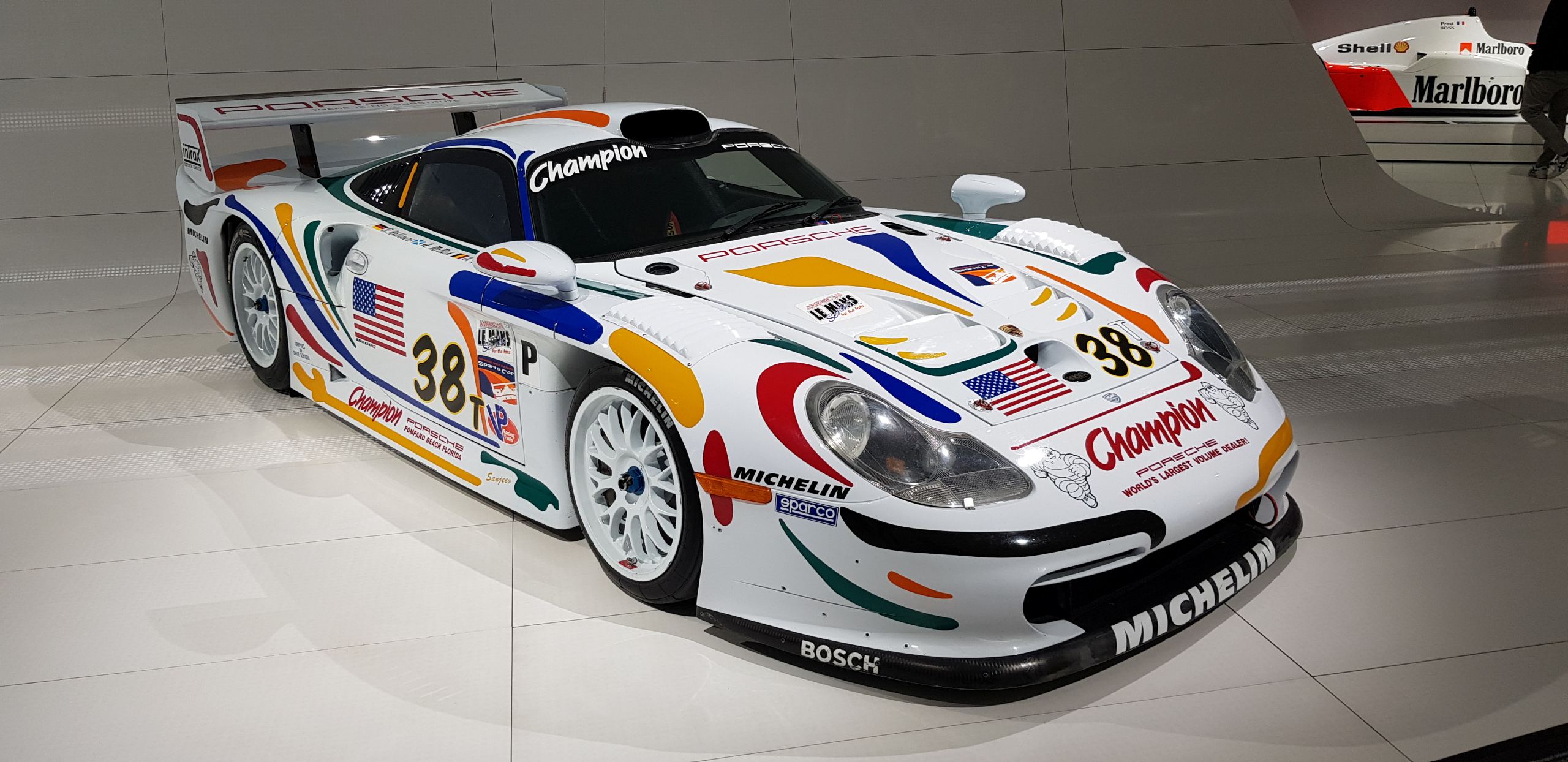
Porsche GT1 Nr. 38 (1998)
The 1998 Porsche 911 GT1, chassis No. 38, represents one of the final evolutions of Porsche’s formidable GT1 programme. While the car was originally listed for the 24 Hours of Le Mans, it ultimately did not compete Instead, it made its mark at the 1998 24 Hours of Daytona, fielded by the American team Champion Motors, piloted by Thierry Boutsen, Andy Pilgrim, and Ralf Kelleners.
Technically identical to the factory GT1-98s that famously secured a one-two victory at Le Mans later that year, this example featured a mid-mounted 3.2-litre twin-turbocharged flat-six engine, producing around 550 PS (542 bhp / 404 kW). A carbon-fibre monocoque, Formula-style double wishbone suspension, and a six-speed sequential gearbox completed the cutting-edge package, all wrapped in an aerodynamically refined body built for endurance speed.
Porsche 911 GT1 Straßenversion (1998)
As part of FIA GT1 homologation requirements, Porsche was obligated to build at least one street-legal version of its 911 GT1 race car. The result was the 911 GT1 Straßenversion (road version) – an extraordinary machine, essentially a Le Mans prototype adapted for the road.
The 1998 iteration was based on the evolved GT1 ’98, introduced after Mercedes-Benz had raised the bar with their dominant CLK GTR. In response, Porsche redesigned the GT1 with a lower and more aerodynamic body, further blurring the lines between road and race car. Thanks to a rule change, only a single homologation model needed to be built – making this GT1 road car a true one-off.
Powered by a 3.2-litre twin-turbocharged flat-six engine, the GT1 Straßenversion delivered approximately 544 PS (536 bhp / 400 kW) and featured a six-speed manual gearbox, mounted in a mid-engine layout – a notable departure from the traditional rear-engine configuration of other 911 models. Acceleration from 0 to 100 km/h (62 mph) took under four seconds, with a top speed of around 310 km/h (193 mph).
Despite its track-focused engineering, the car was equipped with minimal concessions for road use, including headlights, indicators, and basic interior features. With only one unit of the 1998 version produced, it remains one of the rarest and most valuable Porsches ever built.

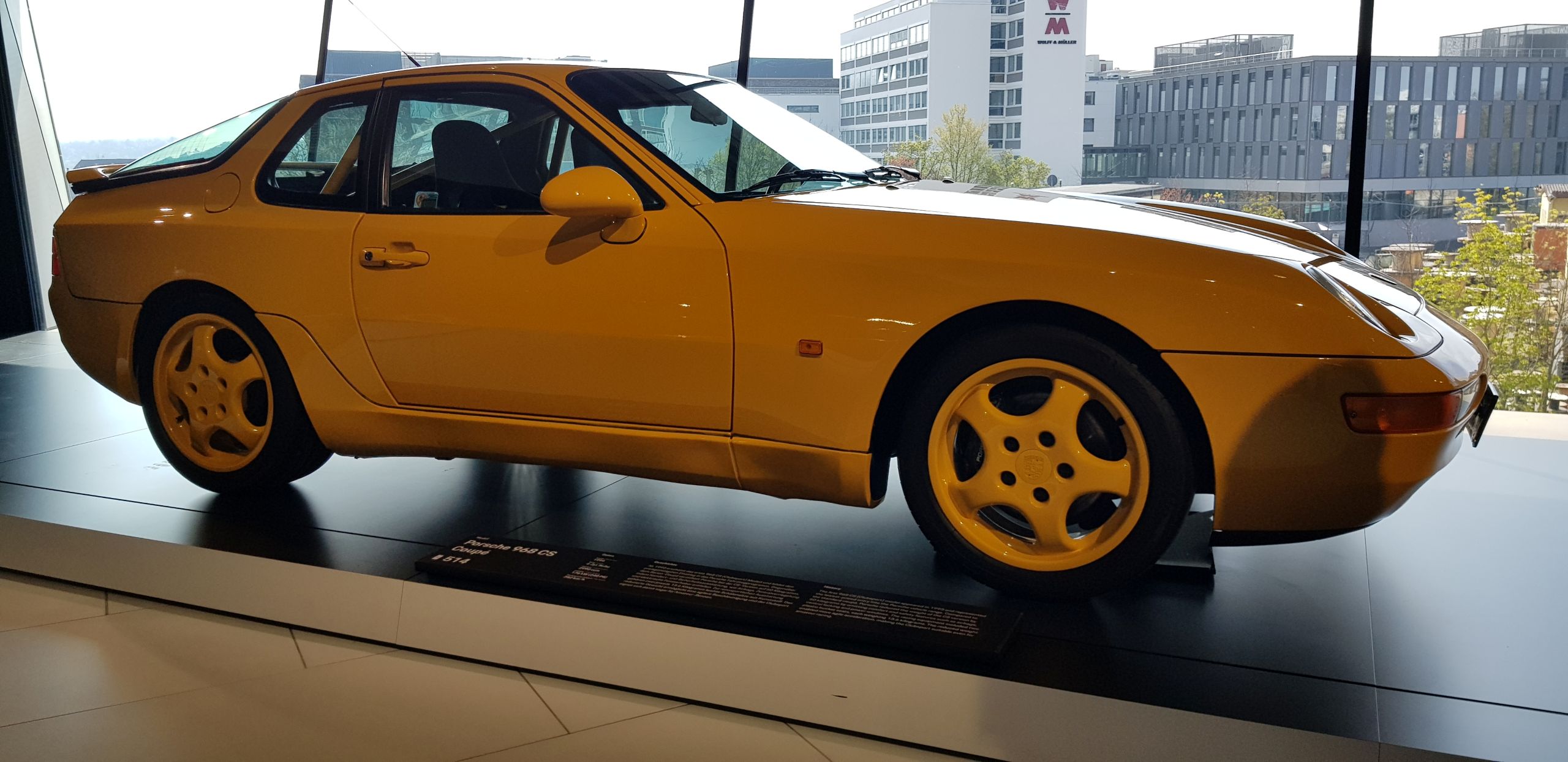
Porsche 968 CS Coupe (1994)
Introduced in 1993, the Porsche 968 CS (Clubsport) was developed as a more focused and affordable entry into the Porsche range. Compared to the standard 968 coupé, the Clubsport shed 50 kilograms (110 lbs) by omitting comfort and safety features such as airbags, central locking and electric windows.
The CS was purpose-built for spirited driving and occasional track use. It came equipped with two lightweight plastic bucket seats, each weighing 13.6 kilograms (30 lbs), enhancing its sporting character. The reduced weight and simplified equipment translated to sharper handling and improved acceleration, making it a favourite among driving enthusiasts and even suitable for amateur motorsport.
Under the bonnet, the 968 CS retained the robust 3.0-litre (183 cu in) inline-four engine, producing 240 PS (176 kW / 237 bhp) – at the time, the largest displacement four-cylinder engine ever fitted to a production car. With a top speed of 252 km/h (157 mph), it combined everyday usability with genuine performance, and remains a cult classic in Porsche’s transaxle era.
Porsche 928 GTS (1995)
Introduced as the final and most refined evolution of the front-engined grand tourer originally launched in 1977, the Porsche 928 GTS represents the culmination of nearly two decades of continuous development. By the time this last iteration appeared in 1992, the 928 had moved far beyond its initial role as a potential 911 replacement and earned its own place as a high-speed luxury GT with formidable performance credentials.
The GTS featured a 5.4-litre V8 engine producing 350 PS (345 bhp) at 5,700 rpm and 500 Nm (369 lb-ft) of torque at 4,250 rpm. Power was transmitted to the rear wheels through either a four-speed automatic or, more rarely, a five-speed manual transaxle, which contributed to the car’s near-perfect 50:50 weight distribution. Acceleration from 0–100 km/h (0–62 mph) was achieved in 5.7 seconds, with a top speed of around 275 km/h (171 mph).
Key distinguishing features of the GTS included flared rear wheel arches, 17-inch Cup wheels, a revised rear wing, and updated side mirrors. The chassis benefitted from Porsche’s Weissach axle, which counteracted lift-off oversteer and improved high-speed stability—a hallmark of the 928’s dynamic competence.
Weighing in at 1,620 kg (3,571 lbs), the GTS offered refined long-distance cruising paired with confident handling, making it one of the most accomplished GT cars of its era. The body was largely constructed from galvanised steel with aluminium doors, bonnet, and front wings to reduce weight.
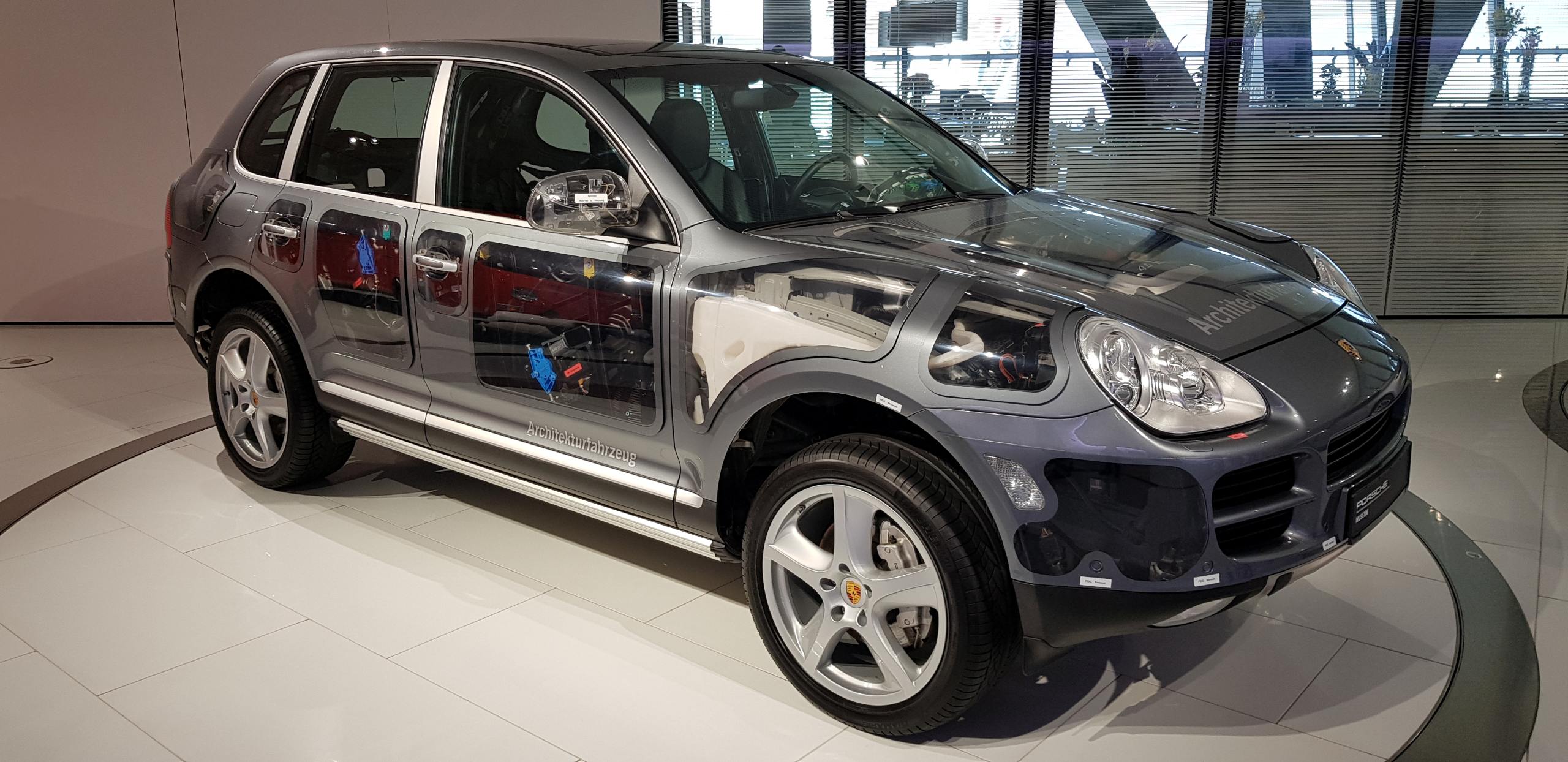
Despite its capabilities and engineering excellence, the 928 GTS remained a niche model. Only 2,831 units of the GTS were built between 1992 and 1995. Its discontinuation marked the end of Porsche’s V8-powered front-engine era until the arrival of the Cayenne SUV in the 2000s.

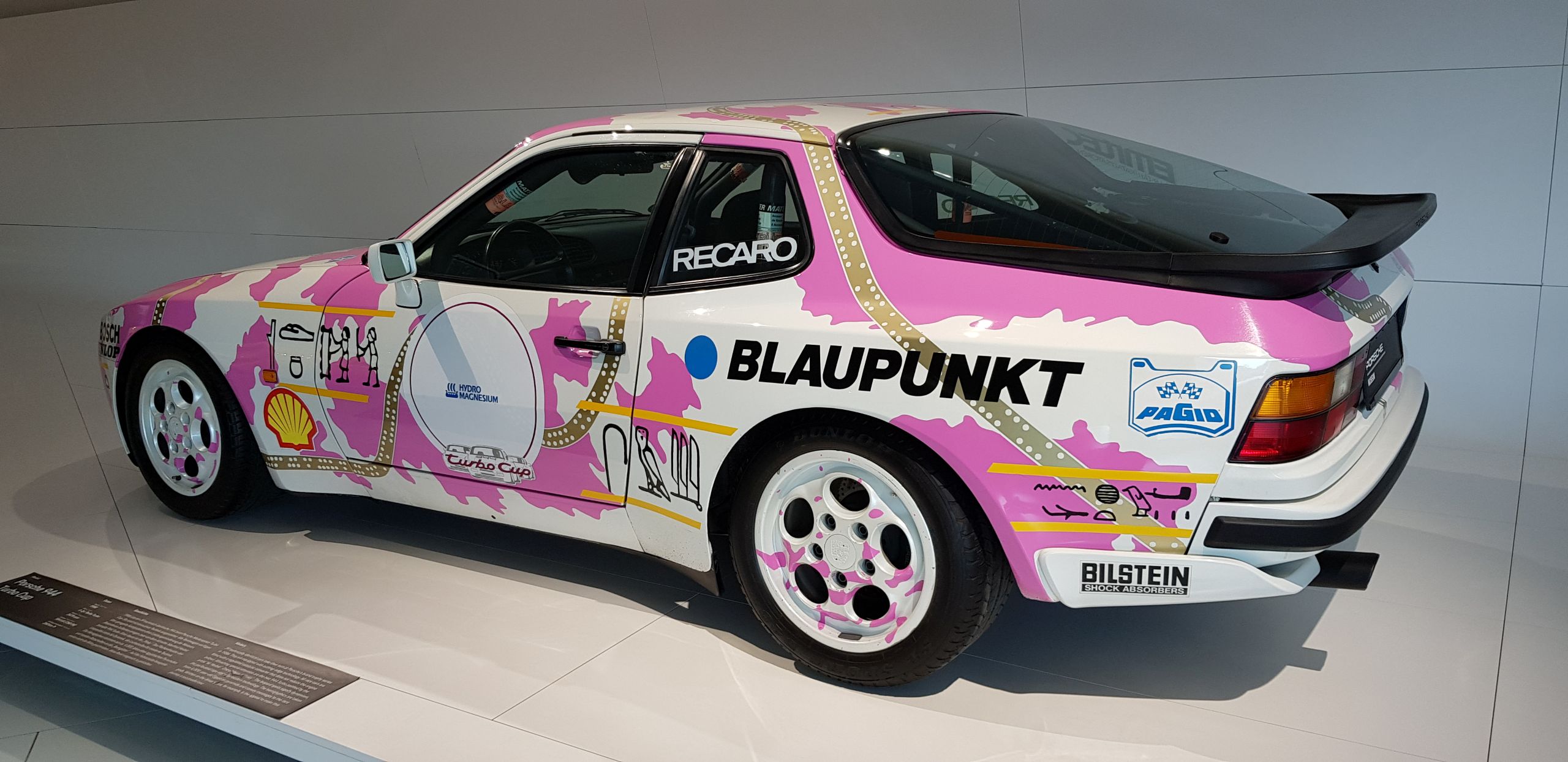
Porsche 944 Turbo Cup “Pinky” (1988)
The Porsche 944 Turbo Cup was a purpose-built competition version of the 944 Turbo (internally known as the 951), developed for Porsche’s one-make race series, the Turbo Cup. In 1986, 39 technically identical examples were prepared for the German Porsche Markenpokal, marking the beginning of what would become a key step in Porsche’s customer racing ladder.
Under the bonnet, the Turbo Cup car featured a modified version of the 2.5-litre inline-four engine found in the road-going 944 Turbo, producing 184 kW (250 PS / 247 bhp) from 2,479 cm³ (151.3 cu in). Porsche engineers achieved this output while still equipping the car with a regulated catalytic converter—a technological highlight for the time, as it allowed compliance with emissions regulations without sacrificing performance. Top speed was around 260 km/h (162 mph).
The Turbo Cup cars were significantly lighter than the standard 944 Turbo, thanks to the removal of unnecessary comfort features and the use of lightweight materials. The suspension was uprated for track use, and the braking system was borrowed from the 911 Turbo (930), offering race-grade stopping power. A close-ratio gearbox and a limited-slip differential further sharpened the car’s already impressive dynamic capabilities.
Among the 39 Cup cars, two stood out visually—painted by German artist Manfred “M.” Herbst. One of them, affectionately known as “Pinky”, gained cult status. Adorned with a wild leopard-spot pattern and ancient hieroglyphics, the design was as much performance art as motorsport livery. The leopard spots symbolised dynamism, while the perforated tape motif represented modernity. The hieroglyphs—borrowed from 4,000-year-old Egyptian pyramids—were intended as messages to the “race gods,” including inscriptions like “Make this journey a victorious one.”
Porsche 904 Carrera GTS (1963)
The Porsche 904 Carrera GTS, designed by F. A. Porsche, was a sensation right from its debut in 1963. Its sleek and low fiberglass body, bonded to a steel ladder chassis, was not only aerodynamically efficient but also visually stunning. This combination of form and function made it a successful race car right from the start.
Powering this specific 904 was a sophisticated 1,977 cc (121 cu in) six-cylinder boxer engine, producing a healthy 118 kW (160 PS / 158 hp). This mid-mounted engine, along with the car’s remarkably low weight of just 640 kg (1,411 lbs), allowed for nimble handling and a top speed of approximately 250 km/h (155 mph).
The Carrera GTS was available both as a dedicated race car and in a slightly more comfortable street-legal version. Its versatility allowed it to compete successfully in various motorsport events, from circuit racing to rallies. Notably, it achieved class victories in prestigious races like the Targa Florio and the 24 Hours of Le Mans.

Porsche 956 (1982)
The 1982 Porsche 956, a ground-effect marvel that looks fast even when hanging upside down (no need to adjust your screen!), was conceived to dominate the new Group C regulations in endurance racing. Its innovative aerodynamic design, particularly the venturi-shaped underbody, literally sucked it to the track, allowing for astonishing cornering speeds.
Powered by a 2,649 cc (162 cu in) twin-turbocharged flat-six engine, the 956 delivered a formidable 456 kW (620 PS / 612 hp). This power propelled the lightweight prototype to a top speed of around 360 km/h (224 mph), making it a force to be reckoned with on any circuit.
The Porsche 956 made its debut at the 1982 24 Hours of Le Mans and achieved a spectacular 1-2-3 victory, immediately establishing its dominance in the sport. This particular car served as a test mule and also played a crucial role in the development of the later, even more successful 7MG turbo engine.
In the autumn of 1983, the car was displayed at the Frankfurt International Motor Show IAA, resplendent in a mother-of-pearl white paint finish. Later, the Porsche Museum acquired the race car and restored it to the iconic livery of the 1980s Porsche works team.

Porsche 944 Cabriolet Studie (1985)
While a pure convertible version of the Porsche 944 wasn’t part of its initial conception, Porsche did eventually introduce a Cabriolet model. Interestingly, the body shells for these open-top versions were modified externally by ASC (Karosseriewerke Weinsberg) in Weinsberg, Germany. This process involved not only removing the roof but also reinforcing the body structure with a second welded floor. The windshield frame was shortened by approximately 60 mm (2.4 inches), and the glass hatch over the rear luggage compartment was replaced with a steel trunk lid.
The 944 S2 Cabriolet was produced from 1989 to 1991, with a total of 6,980 units. An even rarer limited special series of the 944 Turbo Cabriolet saw only 528 examples built.
The standard soft top was manually operated, but an electrically operated version was available as an option and became standard equipment from 1990 onwards. The Turbo Cabriolet variant, produced for only one year, also featured standard air conditioning and held the distinction of being the fastest four-cylinder convertible of its time.
Today, due to its limited production numbers, the 944 Cabriolet is a sought-after classic among Porsche enthusiasts.

Porsche Carrera GT (2003)
The Porsche Carrera GT, produced between 2003 and 2006, stands as one of the most iconic and visceral supercars of the 21st century. Conceived initially as a concept car, its overwhelming public reception led Porsche to bring this extraordinary machine to life.
At the heart of the Carrera GT lies a naturally aspirated 5.7-liter (348 cu in) V10 engine, originally developed for a Le Mans prototype. This magnificent engine produced a spine-tingling 450 kW (612 PS / 603 hp), delivering power in a linear and utterly engaging fashion all the way to its 8,400 rpm redline. The sound it produced was nothing short of automotive symphony.
The Carrera GT was not just about its incredible engine. Its chassis was constructed entirely from carbon fiber reinforced plastic (CFRP), contributing to its exceptional rigidity and low weight of just 1,380 kg (3,042 lbs). This lightweight construction, combined with its potent engine, allowed for breathtaking performance figures, including a 0 to 100 km/h (0 to 62 mph) sprint in around 3.9 seconds and a top speed of over 330 km/h (205 mph).
Another unique feature of the Carrera GT was its manual gearbox with a beechwood gear knob, a nod to classic racing cars. The clutch system, made from ceramic composite, required a deliberate and skilled foot to operate smoothly, further enhancing the driver’s connection with the car.
With its uncompromising focus on driving experience, its stunning design, and its direct link to Porsche’s racing heritage, the Carrera GT quickly became a modern classic. Its limited production numbers and its status as one of the last truly analog supercars have solidified its place as a highly coveted and unforgettable machine.

Porsche 911 997 GT2 (2008)
The 2008 Porsche 997 GT2, often referred to as the “widowmaker” of its time due to its immense power and rear-wheel-drive configuration, was the ultimate high-performance version of the 997 generation 911. This striking red example showcased in the Porsche Museum perfectly embodies its raw speed and focused driving experience.
Powering the 997 GT2 was a 3.6-litre (220 cu in) twin-turbocharged flat-six engine, which produced a staggering 390 kW (530 PS / 523 hp). This immense power was sent exclusively to the rear wheels through a manual gearbox, demanding respect and skill from the driver. The resulting performance was electrifying, with 0 to 100 km/h (0 to 62 mph) achieved in around 3.7 seconds and a top speed of approximately 329 km/h (204 mph).
Visually, the 997 GT2 was distinguished by its aggressive aerodynamic package, including a large fixed rear wing, a deep front spoiler with prominent air intakes, and lightweight alloy wheels. These elements not only contributed to the car’s menacing appearance but also generated significant downforce for enhanced stability at high speeds.
Compared to the standard 911 Carrera models, the GT2 featured numerous weight-saving measures, including the use of lightweight materials and the omission of the rear seats. The suspension and braking systems were also significantly upgraded to handle the extreme performance.

Porsche 911 GT3 R Hybrid (2010)
In 2010, Porsche broke new ground by combining hybrid technology with uncompromising motorsport engineering in the 911 GT3 R Hybrid. Designed purely for racing, this experimental vehicle was far more than a technological showcase—it was a serious endurance contender. At its heart lay a 4.0-litre (3,996 cm³) flat-six engine producing 353 kW (480 PS; 473 bhp), sending power to the rear wheels. What set it apart, however, was the addition of a front-axle hybrid system, comprising two electric motors each rated at 60 kW (81 PS; 80 bhp).
Unlike conventional hybrids, the GT3 R Hybrid didn’t rely on batteries. Instead, it featured a high-speed flywheel accumulator developed with Williams Hybrid Power. This system recovered braking energy and stored it mechanically, releasing it on demand to boost acceleration—particularly useful when overtaking or exiting corners. The result was a temporary all-wheel drive setup that could be summoned at the driver’s discretion.
The GT3 R Hybrid wasn’t just a theoretical exercise: it competed in real races, most notably the 24 Hours of Nürburgring, where it stunned spectators by leading large portions of the race until a mechanical failure ended its run. Despite not finishing, the message was clear—hybrid systems could offer a competitive edge even in the grittiest of racing environments.
With a top speed of 295 km/h (183 mph), this 911 wasn’t about straight-line records, but about pioneering a new chapter in motorsport. It helped pave the way for the hybrid Porsche 918 Spyder and demonstrated how intelligent energy management could translate into genuine on-track performance.

Porsche 991 911 R (2016)
The 911 R from 2016 was Porsche’s love letter to purists. Limited to just 991 units worldwide, it combined the raw mechanical essence of a GT3 RS with a bespoke body and—most importantly—a six-speed manual gearbox. No rear wing. No dual-clutch PDK. Just lightweight materials, rear-wheel drive, and driver engagement distilled to its purest form.
Under the skin, the R borrowed the 4.0-litre naturally aspirated flat-six from the GT3 RS, delivering 368 kW (500 PS; 493 bhp) at a screaming 8,250 rpm. With a curb weight of just 1,370 kg (3,020 lbs), it was lighter than the GT3 RS and more focused on balance and feel than downforce and lap times. The red racing stripes were more than just a nod to the original 911 R from 1967—they were a symbol of Porsche’s racing soul reborn for the road.
What made the 911 R legendary wasn’t just its performance—0–100 km/h in 3.8 seconds and a top speed of over 320 km/h—it was the way it made drivers feel. It offered one of the last truly analogue experiences in a digital age, just before the manual GT car era seemed to be ending.

Porsche 918 Spyder Concept (2010)
Unveiled at the 2010 Geneva Motor Show, the 918 Spyder Concept stunned the automotive world. It promised the impossible: the performance of a supercar with the efficiency of a compact vehicle. A naturally aspirated V8 paired with front and rear electric motors—capable of driving emissions-free or delivering breathtaking acceleration. A glimpse into Porsche’s future, packaged in one of the most beautiful bodies the brand had ever shaped.
Its 4.6-litre (4593 ccm) race-derived V8, mounted midship, produced over 500 PS (493 hp) on its own. Combined with the electric motors, total system output exceeded 700 PS (690 hp). Unlike the production car, the concept featured dual exhausts exiting low on both sides—hinting at its experimental nature, before the top-mounted “top pipes” became an icon on the final car.
The design was lightweight, purposeful, and aggressive. Yet it remained elegant, even minimalist—its silhouette free of clutter, its surfaces clean, and its interior a futuristic study on driver focus. The green brake calipers and accents weren’t just styling flourishes—they underlined the car’s environmental ambitions.

Porsche 919 Hybrid (2016)
The 919 Hybrid wasn’t just a race car—it was Porsche’s statement of intent. After a 16-year absence from the top class of Le Mans, Porsche returned in 2014 with the 919. By 2015, it had won. By 2016, it had dominated. This is the car that claimed Porsche’s 18th overall Le Mans victory—and began a new era of hybrid endurance racing.
Beneath its carbon shell lay a masterpiece of complexity: a 2.0-litre V4 turbocharged engine, paired with dual energy recovery systems—one kinetic (KERS) from the front axle, one thermal from the turbo. Together, they fed a lithium-ion battery powering an electric front-axle motor. The result? Over 900 PS (887 hp), delivered through all four wheels.
The 919 was purpose-built for the LMP1 category, where efficiency mattered as much as speed. Its monocoque was feather-light, its aero endlessly optimised, and its hybrid systems tuned to perfection. And it wasn’t just fast—it was intelligent, adapting strategy and power deployment in real time.
In 2016, it won Le Mans by a margin of minutes—after 24 hours of relentless pace, precision, and pressure. It also clinched the World Endurance Championship. Twice. Porsche had returned to the pinnacle of motorsport—and planted its flag on top.

Porsche 356 A 1600 Super Coupe (1956)
By 1956, the Porsche 356 had matured. Introduced in 1948 as Porsche’s first production model, the 356 set the tone for everything that followed: lightweight, rear-engined, and thrillingly nimble. The “A” series, introduced in late 1955, marked the car’s first significant update—with refined styling, improved brakes, and a broader engine range.
The 1600 Super was one of the most desirable variants of the time. Its air-cooled, 1.6-litre (1,582 cc / 96.5 cu in) flat-four engine produced 75 PS (74 bhp / 55 kW), enough to propel the Coupé to a top speed of around 175 km/h (109 mph). With a kerb weight of just 885 kg (1,951 lbs), the car delivered lively performance, especially in comparison to most contemporaries in its class.
Porsche engineers enhanced driveability and comfort in the 356 A by revising the suspension and introducing a more efficient synchromesh gearbox. The bodywork also became sleeker: a single-piece curved windscreen replaced the earlier split design, improving both visibility and aerodynamics.
The Super variant was visually restrained—no wild graphics or badges gave it away. But keen drivers knew what to look for: the “Super” script on the rear and a livelier response underfoot. It was a gentleman’s sports car—fast, composed, and built to be driven.

Porsche 911 Turbo S “Duet” (2020)
The 2020 Porsche 911 Turbo S “Duet” is an exceptionally rare and exclusive offering, limited to just ten examples worldwide. This unique collaboration between Porsche and Brazilian aircraft manufacturer Embraer grants buyers of the Phenom 300E jet the exclusive right to purchase one of these bespoke 992 Turbo S models.
This special edition, crafted by Porsche Manufaktur, features a unique design language that visually links it to the Phenom 300E. A custom logo, combining a stylized wing and the 911 Turbo’s rear spoiler, is placed on the headrests and B-pillars, the latter also featuring ten squares with one highlighted in the exclusive Speed Blue – a color that can be chosen by the owner to match their jet and is also applied to the aircraft.
The exterior boasts a distinctive dual-tone finish in glossy Platinum Silver Metallic and satin Jet Grey Metallic, mirroring the jet’s livery. Aviation-inspired “No Step” lettering adorns the door sills. Inside, Speed Blue accents the steering wheel’s 12 o’clock marker and the contrast stitching. The underside of the rear spoiler also features the jet’s individual registration number. The Sport Chrono clock on the dashboard even incorporates a printed artificial horizon. Brilliant Chrome painted air intakes subtly reference the jet’s engines.
Completing this exclusive package is a limited edition Porsche Design 1919 Globetimer UTC watch and a matching luggage set, making the 911 Turbo S “Duet” a truly unparalleled collector’s item that seamlessly blends the worlds of high-performance automotive engineering and aviation.

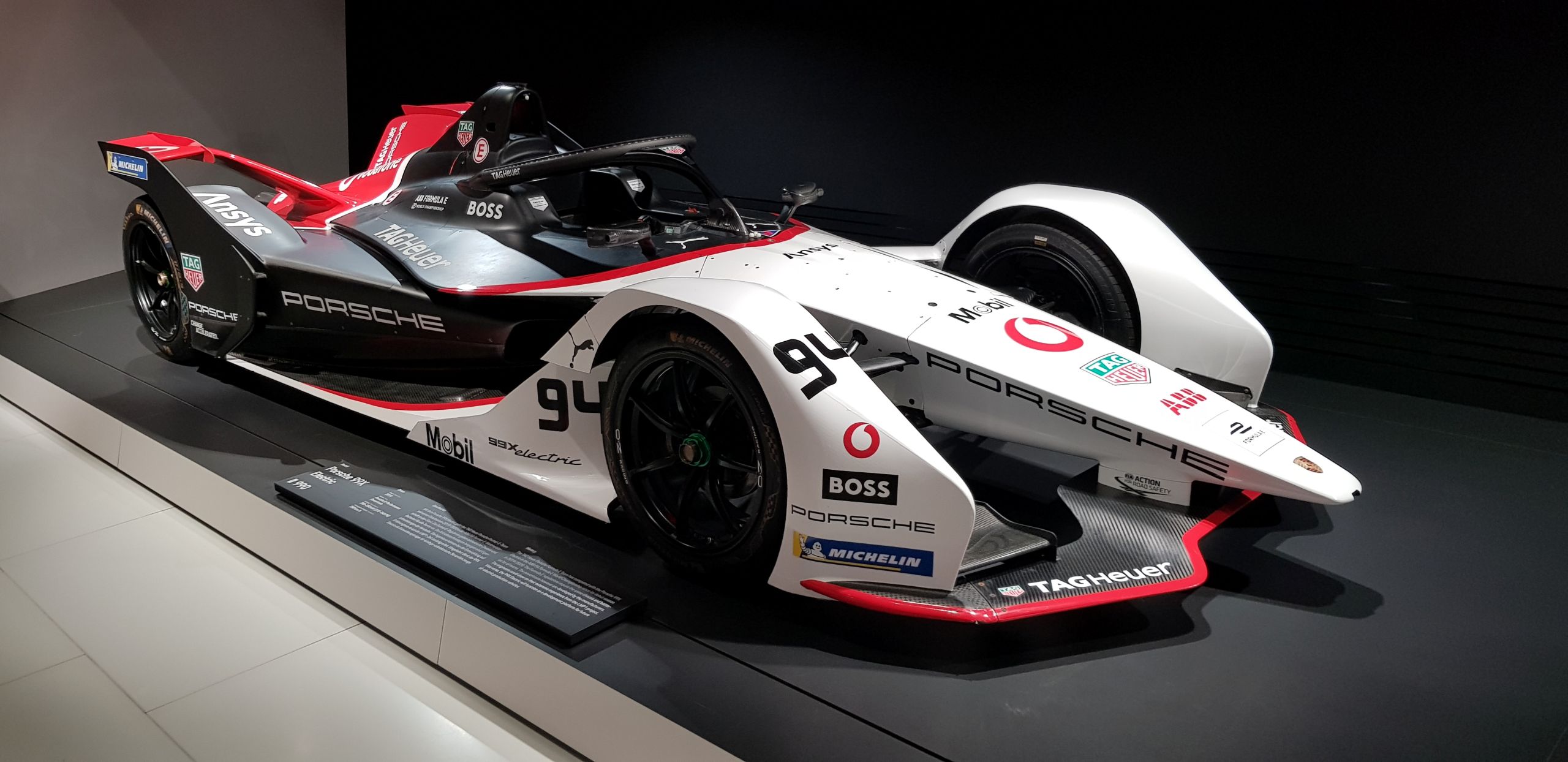
Porsche 99X Electric
The TAG Heuer Porsche Formula E Team has competed with the Porsche 99X Electric in the ABB FIA Formula E World Championship since its debut season in 2019/2020. The Formula E regulations require the same chassis and battery for all teams. The powertrain, however, is developed by the manufacturers.
Porsche engineered the 99X Electric’s powertrain, drawing upon their extensive experience from the Le Mans Prototype (LMP1) program. This in-house development focused on efficiency and performance within the strict limitations of the Formula E rules. The electric motor and inverter were key areas of innovation.
The 99X Electric boasts a maximum power output of 250 kW (340 PS / 335 hp) in qualifying mode and 200 kW (272 PS / 268 hp) in race mode, with the potential for temporary power boosts through “Attack Mode” and “Fanboost.” Acceleration from 0 to 100 km/h (0 to 62 mph) is achieved in approximately 2.8 seconds, with a top speed limited by the circuit layout.
Visually, the 99X Electric features the distinctive Porsche motorsport livery, often incorporating elements of the team’s sponsors. The car represents Porsche’s commitment to electric mobility and its application in high-performance racing.
Beyond its racing endeavors, the Porsche 99X Electric also serves as a crucial development platform for future all-electric production vehicles from Porsche, pushing the boundaries of electric powertrain technology and energy management.
Porsche 911 Turbo Nr.1 (1974)
In September 1974, Louise Piëch received this very special Porsche 911 on the occasion of her 70th birthday. This early example of the original 911 Turbo model was based on the narrow body of the standard 911 Carrera. It came with a unique tartan interior and a platinum metallic exterior paint.
Its 2.7-litre flat-six engine, equipped with a KKK turbocharger, produced an impressive 176 kW (240 PS / 237 hp). This marked the beginning of the legendary 911 Turbo era, combining everyday usability with exhilarating performance. The top speed of this early Turbo was around 250 km/h (155 mph).
The “Nr. 1” designation highlights its significance as one of the very first production 911 Turbo models. Its special features, including the exclusive paint and the tartan interior, further underscore its unique status as a personal gift.

Porsche Vision Granturismo Vexx (2021)
The Porsche Vision Gran Turismo Vexx, unveiled in 2021, is a virtual concept car developed exclusively for the Gran Turismo 7 video game. It represents Porsche’s futuristic vision of a high-performance electric racing machine, unbound by real-world production constraints. The Vexx livery was created in collaboration with the digital artist Vexx from Belgium. The striking design, with its sharp lines, aggressive aerodynamics, and vibrant color scheme, showcases a unique blend of Porsche’s design DNA and the artist’s distinctive style. This version was presented to the public at Gamescom in 2022.
The Vision Gran Turismo Vexx is powered by two permanently excited synchronous motors, delivering a maximum power output of 950 kW (1,292 PS / 1,274 hp). This virtual power allows for incredible acceleration and a projected top speed of over 350 km/h (217 mph) within the game environment.
Key design elements include the low-slung silhouette, the prominent rear wing with integrated light bar, and the futuristic wheel design. The interior is equally radical, focusing on the driver with a minimalist and highly functional layout.

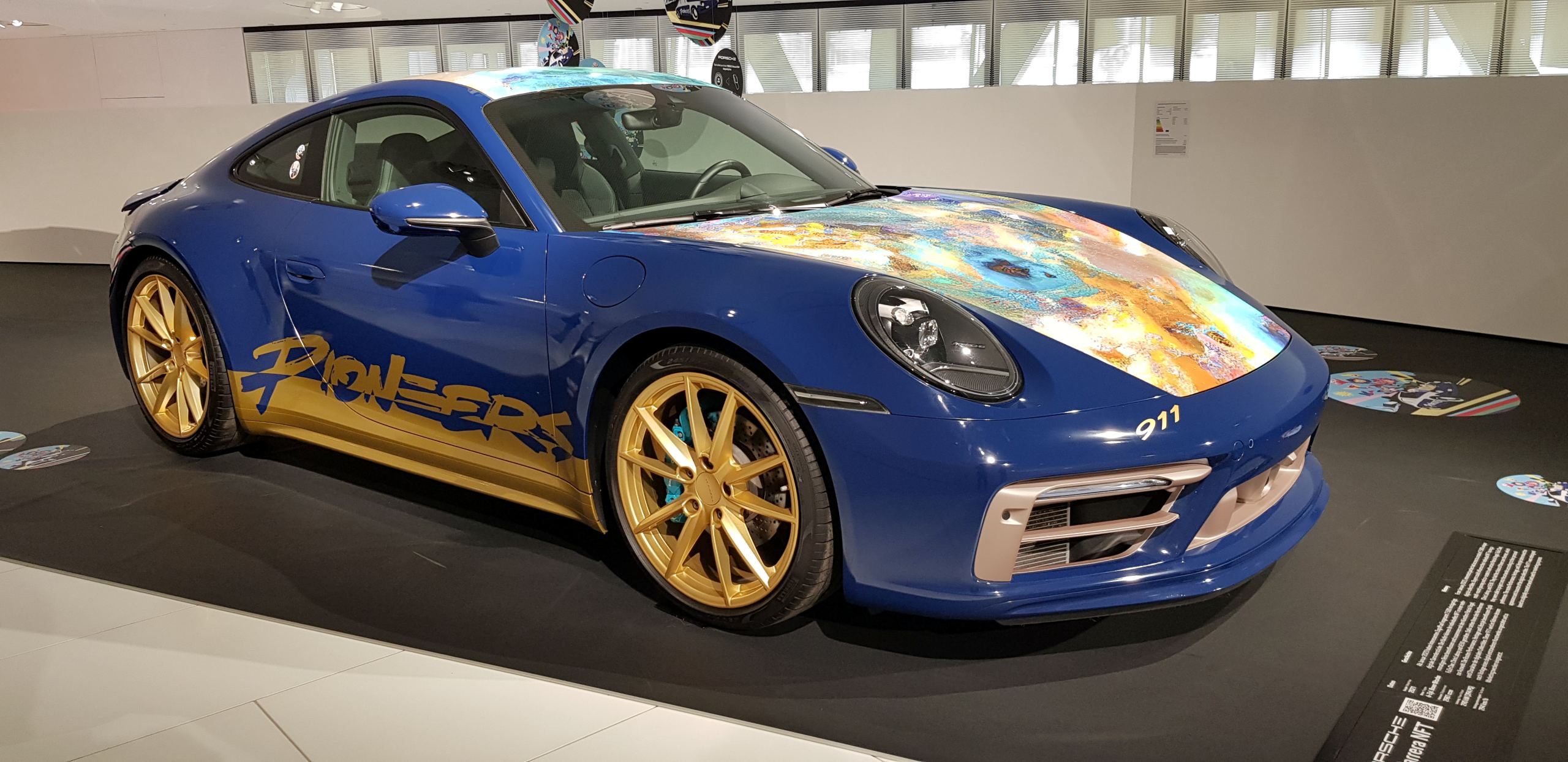
911 Carrera NFT (2021)
From January 2023, Porsche offered a total of 7,500 unique digital collectibles. Buyers could acquire individual NFTs (Non-Fungible Tokens) in various rarity levels: Rare, Legendary, and Epic. The design of these tokens was inspired by iconic Porsche models such as the 911, 911 Turbo, and 911 GT3. They were created in collaboration with the artists like Patrick Vogel and FaZe Clan.
The digital artworks feature rotating 3D models of the cars, showcasing their iconic design elements and characteristics. The rarity level influenced the animation, perspective, and additional features of the digital collectible. The NFT served as a digital collector’s item and a marketing instrument.
Austro-Daimler ADS R Sascha (1922)
The Austro-Daimler ADS R “Sascha” represents an early and fascinating chapter in the history of lightweight sports cars. Designed by Ferdinand Porsche, who was working for Austro-Daimler at the time, the “Sascha” was conceived with a focus on agility and efficiency for the Targa Florio race.
Its small but spirited 1,100 cc (67 cu in) four-cylinder engine produced a modest 33 kW (45 PS / 44 hp). However, thanks to its lightweight construction of around 598 kg (1,318 lbs), the “Sascha” was surprisingly nimble and capable, achieving a top speed of 144 km/h (89 mph) – remarkable for its era.
The car’s name, “Sascha,” came from Count Sascha Kolowrat-Krakowsky, an Austrian film producer and enthusiastic supporter of Austro-Daimler who championed the development of a small, competitive race car.
In the 1922 Targa Florio, the Austro-Daimler team entered three “Sascha” models, and they achieved significant success in their class, demonstrating the effectiveness of Porsche’s lightweight design philosophy. The “Sascha” not only proved its racing prowess but also influenced the development of future lightweight sports cars.

Lohner Porsche Semper Vivus (1900)
The Lohner-Porsche “Semper Vivus,” meaning “always alive” in Latin, represents a groundbreaking early example of a hybrid electric vehicle. Designed by Ferdinand Porsche for the Lohner company, this innovative car used a series-hybrid system.
It was powered by two 2.5 hp (1.8 kW) electric motors, one integrated into each of the front wheels, making it an early example of front-wheel drive, not all-wheel drive. These electric motors received their power from batteries, which were in turn charged by two 3.5 hp (2.6 kW) single-cylinder Daimler gasoline engines acting as generators. This eliminated the need for a large, heavy battery pack and extended the vehicle’s range significantly.
The “Semper Vivus” was initially conceived for the Paris World Exposition of 1900 and garnered considerable attention for its advanced technology. While the original was a unique prototype, the example displayed in the Porsche Museum is a reconstruction built starting in November 2007, honoring this pioneering vehicle.
The car’s design also featured a unique “Mixte” (mixed) system, where the gasoline engines could directly contribute to powering the electric motors at higher speeds, further optimizing efficiency. The Lohner-Porsche “Semper Vivus” achieved a top speed of approximately 35 km/h (22 mph), which was respectable for the time.

Egger-Lohner C.2 Phaeton or P1 (1898)
The Egger-Lohner C.2 Phaeton, built in 1898 and also known as the P1 (Porsche number one), holds a significant place in automotive history, particularly in connection with the early work of Ferdinand Porsche. From 1897 onwards, Egger-Lohner was an automotive company, not solely an electrical engineering firm, and the C.2 Phaeton was one of the vehicles designed there by the then 23-year-old Porsche.
This electric carriage was powered by an octagonal electric motor, also designed by Porsche. It produced around 3.7 kW (5 PS / 5 hp) and could propel the Phaeton to a top speed of approximately 25 km/h (16 mph), with a range of about 80 kilometers (50 miles) on a single charge – impressive figures for the time. The motor was notable for its lightweight construction.
The C.2 Phaeton was entered in several early automobile races, which served as important tests for the vehicle’s reliability and performance. Perhaps its most famous moment came in 1899 at the International Motor Car Exhibition in Berlin. Ferdinand Porsche himself drove a C.2 Phaeton in an endurance race over a distance of 40 kilometers (25 miles) and won the gold medal, showcasing the potential of electric propulsion.
The design of the C.2 Phaeton was typical for horse-drawn carriages of the era, with high wheels and an open body. However, instead of horses, it was driven by the silent and innovative electric motor.

Bonus Images and Information


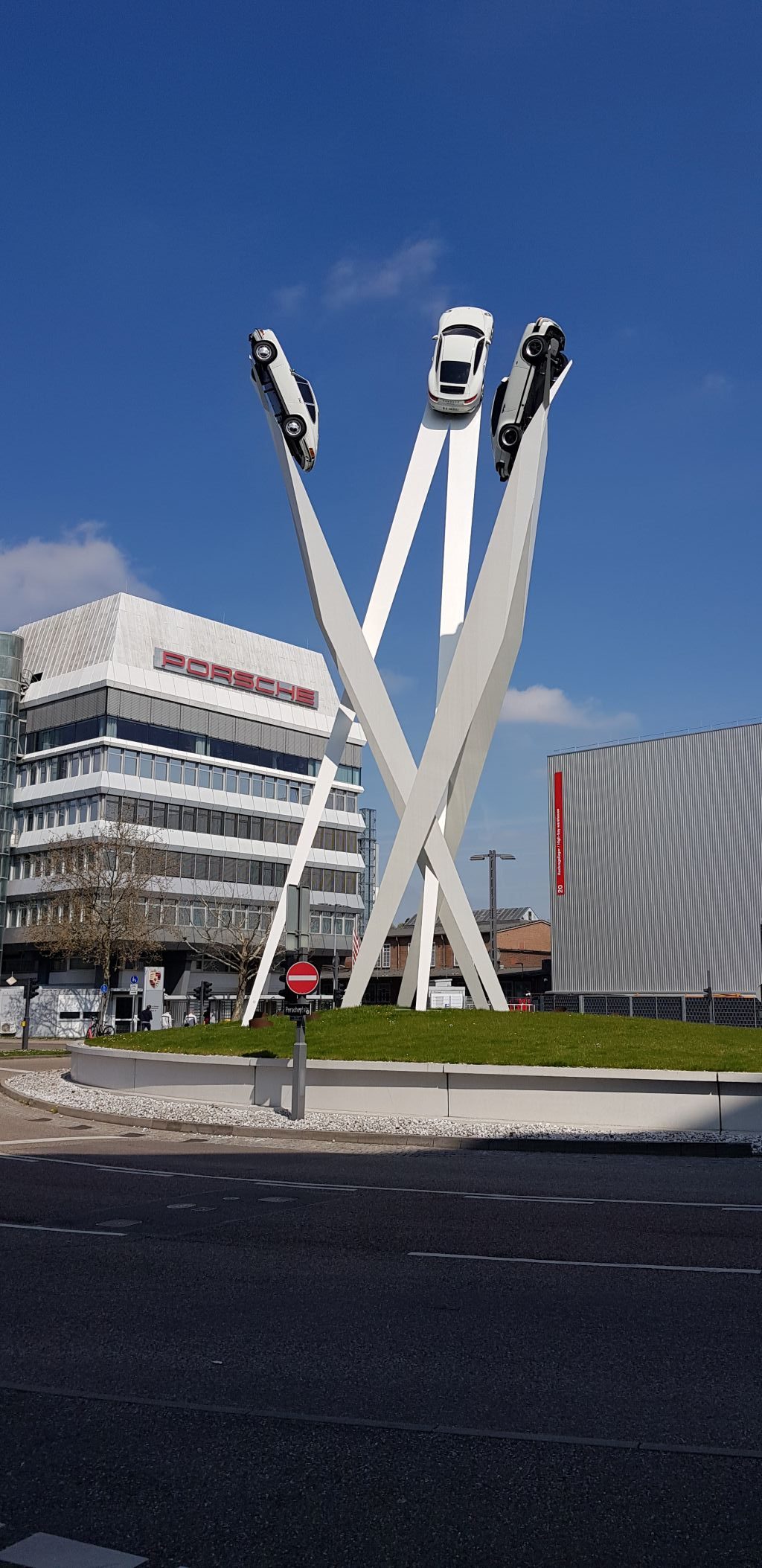
Let’s take a closer look at the monument that you will encounter at the Porscheplatz outside of the museum.
One of the soaring stelae points towards Austria. In Gmünd, Carinthia, Ferry Porsche brought the very first Porsche sports car, the original 356, to life in 1948. Furthermore, Zell am See in Austria is the final resting place of Ferdinand, Ferry, and Ferdinand Alexander Porsche, underscoring the deep familial ties to this Alpine nation.
A second stele is oriented towards Weissach. This location is the heart of Porsche’s research and development, where all their sports cars are conceived, engineered, and brought to production readiness. It also serves as the headquarters for Porsche’s esteemed motorsport division, highlighting the brand’s commitment to performance and innovation.
The third stele directs its gaze eastward, towards the Free State of Saxony. This region is significant as the current production site for Porsche’s four-door vehicles, demonstrating the brand’s expansion beyond its traditional two-door sports car roots. Moreover, not far from Leipzig, in Schwarzenberg in the Ore Mountains, Porsche recently acquired the Porsche Werkzeugbau GmbH (formerly Kuka Systems), further emphasizing the company’s strategic growth and investment in manufacturing capabilities in this eastern German state.
Conclusion
From the moment the factory tour begins at the museum entrance, you’re immersed in the inner workings of one of the world’s most iconic sports car manufacturers. The behind-the-scenes look at how the Porsche 911 is built — from bare metal shell to the symbolic “marriage” with its engine — reveals a production process unlike any other, shaped by vertical space constraints and guided by lean, purposeful automation.
The atmosphere inside the factory is strikingly focused and calm, reflecting the brand’s dedication to detail and quality. From driverless transport systems to meticulous final inspections, every step embodies Porsche’s engineering philosophy. After returning to the museum, visitors can explore the company’s storied motorsport legacy and legendary models on display, rounding off an experience that perfectly blends past, present, and future.
Also make sure to check out my other blog post about visiting Mercedes-Benz factory and museum.